

Sean Rice (2013 ICF Ocean Racing World Champion, 2017 Molokai Challenge Champion plus a host of other titles) of PaddleLife and Huksu Coaching recently re-published these tips for improving your surfski paddling. As I read through them I found I had a whole lot of questions, so I called Sean at his office in London and he kindly chatted through them with me.
Additional Info
-
Content Part 2
Tip 4: Paddle Intervals on Flat Water
I would suggest most of your interval sessions should be done on flat water, and the long distance paddles on the ocean. Speed and power should be all you are worrying about during interval sessions. Obviously take what you get water wise, but a good idea is to try timing your interval sessions for the less windy days (or parts of the day).
I’ve heard that some elite paddlers take a regular session out to focus on technique (form) rather than speed or strength. What’s your take on that?
I don’t allocate entire sessions to technique, but rather focus on technique at specific times during interval sessions. For example, when you’re tired at the end of a 10x4 session, you really need to make sure that your stroke isn’t deteriorating.
So yes, I do focus on technique during training, but I don’t devote whole sessions to it.
If you do decide to do technique sessions, make sure you have a coach check your technique to give you feedback; you might be practising bad form! It’s easy for a coach to critique your technique from a video, even a couple of short clips taken from the bank by someone with a phone.
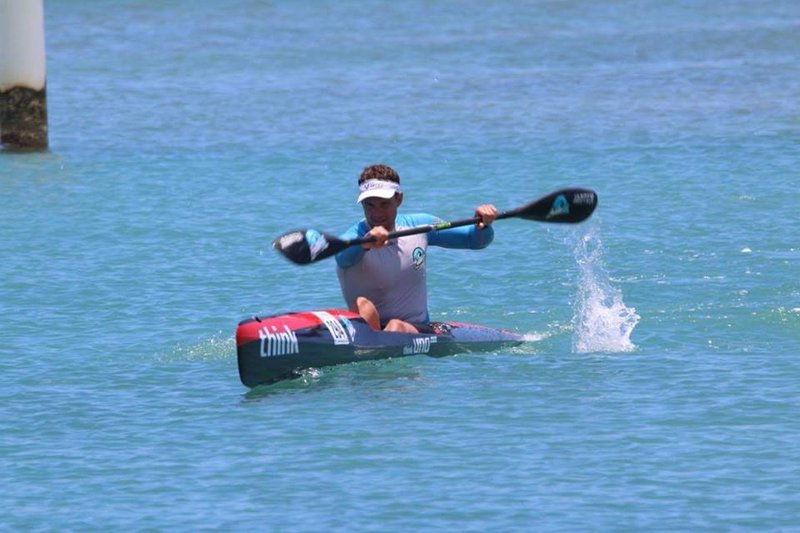
After 50km of heat, chop and current, Sean Rice shows phenomenal form as he approaches the finish line in the 2017 Maui Jim Molokai Challenge
Tip 5: Go Downwind!
For ocean paddling, I would always choose downwind paddling if I have the choice. It takes a lot of skill and time to perfect downwind paddling, and it is fun, so it only makes sense to do it as much as possible! I personally like circuit courses as well every few sessions, as it gives you a bit of everything.
Some elite paddlers seem almost relaxed on the runs, using (seemingly) little energy, while others seem to sprint the whole way, pulling over runs and using a whole lot of energy! What’s your take on that?
It depends on the circumstances, like the distance of the race (when you have to conserve energy; you can’t sprint for 50km, even downwind!) and what’s happening around you. Elite paddlers have a game plan so that, for example, if they think they’re far enough ahead, they’ll pull back a bit and use just enough energy to work the runs to stay ahead.
On the other hand, if they’re neck and neck with the opposition and they only have 5km to go, you’ll see them using a high stroke rate, pulling over the next wave, etc.
It was only when I viewed some of my own videos taken with a Garmin VIRB camera that shows your speed, that I really saw how much you slow down when you wallow off a wave and it became clear how very important it is to keep the boat speed up by not trying to catch every single wave, but rather going slightly slower and staying on your wave until you see the next wave in front of you.
You’re right – and something to realise is that it happens to all of us, including the elite paddlers! You need to try to ride the crest of the wave, watch all the time for the next one in front and then go for it.
Tip 6: Spend Time in the Boat
An unfortunate reality: the best tip for gaining competency on the ocean really is “time in the boat”. Keep going out and get your confidence up, and that will have the biggest positive affect on your paddling.
It’s interesting how confidence seems to have a direct effect on stability. But we all have bad experiences; I remember my very first paddle in my Fenn Elite. I was very confident at the time and was looking forward to a fantastic downwind.
But the conditions were exceptionally challenging: the first couple of km had a very strong side-wind and side-chop combined with big breaking swell from behind. I was shocked to find that not only was I bracing constantly, but I was actually afraid and felt out of control, my confidence shattered. How do you come back from that?
It happens to everyone! There are steps you can take to accelerate your recovery from such incidents:
- Get back on the water as soon as possible. The longer you leave it, the stronger the loss of confidence.
- Go back to basics. If you’re on a new, tippy boat, get back on your old boat and paddle on flat water. Recreate the conditions in which you felt more confident.
- If the situation was caused by challenging conditions, don’t go straight out into that situation again. Work up to it by, for example, doing a downwind in less crazy conditions.
Tip 7: Be Comfortable
Comfort (i.e. stability) directly affects your confidence in the boat, which directly affects your boat speed. Being comfortable is building block number one so boat choice is very important. I like to explain it to people this way: yes, an elite boat such as the Think Uno Max may be super-fast, but with surfski paddling if you miss just one stroke it can make the difference. It only takes one missed stroke to miss one run, which unfortunately can cost you 50-60m! Miss a few strokes during a race and all of a sudden it makes more sense to slide back into the THINK Evo etc, which is more stable so that you don’t sacrifice your overall speed.
“Stability before Ability”! But what about the actual comfort of the seat (rather than the stability of the boat)? What if the seat is rubbing your coccyx raw?
One thing you can try is to use a bum pad; I’ve used one in every single boat I’ve ever paddled. There are several advantages: being raised even a little above your heels gives you better posture for paddling. And a properly installed pad (which means the notch in the pad should be positioned towards the tail of the ski) should prevent contact between your coccyx and the surface of the seat, preventing rubbing.
For me the correct set up means that I can slide my hand down behind my back and touch the area just above the coccyx.
The bum pad does make the boat slightly less stable – but if one bum pad makes the boat so unstable that you feel uncomfortable, that’s probably a sign that the boat is too tippy for you anyway!
Tip 8: Set Goals
Set GOALS! Make them attainable goals so that you know where you’re heading and what you want to achieve from your training – and never be shy to ask the paddlers around you for advice!
Obvious goals would be choosing a race or a series to work towards; what other goals should we be looking at?
The easiest thing is to choose a race to work towards, but really it's all about quantifying your progress. Keep records and choose a route or a specific distance and do it every couple of weeks. Then you can actually see the improvement over time and that can help keep you motivated. I've seen so many people get into a rut with their paddling - even though they're improving, it doesn't help if they haven't quantified the improvement.
Finally – what’s on the cards for Sean Rice?
In the next couple of weeks, I’m off to the Amsterdam Waterland Marathon, then to Villajoyosa in Spain to take part in the EuroChallenge race. After that it’s the US Tour and then a busy schedule in Europe.
It’s incredible how the Europeans have taken to surfski paddling and how many races there are.
In Spain they have a massive youth programme; at most of the big races they have a youth race, either 3 or 5km first. I fully expect to see a world champion from Europe in the next 10 years.
The future looks good - both for Mr. Rice and for the future of surfski paddling!
To find a Sean Rice/Paddle Life coaching clinic near you, click here.
Follow Sean Rice on Facebook at:
Just how do you go about improving one of the all-time classic surfskis? Epic Kayaks just launched the third generation V10 – and I spoke to Greg Barton, Epic's CEO and chief designer, to find out how and what he changed in the design.
Additional Info
-
Content Part 2
What were your goals with the redesign?
We’ve had a lot of very positive feedback on the latest V12 – especially for downwind paddling. But the V12 is an elite level ski. Most advanced level paddlers (just below elite) lose a little with V12 stability in big conditions. They’d perform better with something that is more user friendly.
The relatively straight keel (minimal rocker) on the Gen 2 V10 makes it very fast on flatwater and smaller conditions (harbors). These customers have been asking for something that surfs and handles better in downwind conditions.How do go about design? Is it all CAD, experience or art – or a combination of all three?!
Designing for downwind is part science, and part experience & art.
Flatwater speeds and stability are easier to model and predict. Downwind surfing becomes more art, although I did manage to work up a simulation to give basic handling comparisons between hulls.
When re-designing a ski (or doing a new model), I look at the purpose of the boat – in this case a downwind surfing machine that good/advanced level paddlers can handle comfortably.
The entire design is done on computer. I look at the length, width, rocker profile and volume distributions. Then I create several iterations (with varied features) of CAD surfaces and compare them. It’s always a compromise. The faster versions likely aren’t as stable, or one that performs well on flat water does not work as well in downwind conditions. Once I’m happy with one of the new designs, we cut a plug with our CNC machine and make a boat to test.
Two years ago, we produced 3 prototype versions of the new V12 with different seat positions and sent them to Hawaii for testing. Based on feedback from the testing, the final production Gen 2 V12 used neither of those positions (it was between 2 of the test versions).We also modified the flare and deck for the final version. This data was then extrapolated to give the best seat position for downwind performance on the Gen 3 V10. Customers are raving about the comfort of the Gen 2 V12 seat and the V11 seat. But we’ve had a few who found those seats just a little too tight – so we added a few mm to the Gen 3 V10 seat relative to the V11 and V12, while keeping a nice low hump under the knees for good leg dive.
From reading the website, the positioning of the V10 relative to V12 is fairly clear: the V12 is slimmer, less stable, for paddlers with excellent balance. The V14 even more so, fastest on the flat, but even elite paddlers might switch back to the V12 in rough water.
The V14 was never intended to be a great downwind ski. It was designed to be extremely fast for elite level paddlers in smaller conditions. The V12 in now the boat of choice for those (elite) paddlers in rougher conditions.
The V11 is a shorter version of the V12. Stability is similar in the 2 boats. There are several reasons why a paddler may choose the shorter V11.The shorter length may handle better in certain (short & steep) wave conditions. Some customers may prefer a shorter boat for storage or transport issues. I’ve done extensive controlled testing of the V11 vs. V12 on flat water.
For my weight (80 kg), the longer V12 is marginally faster (a few tenths of a percent) on perfectly flat water. But that advantage may disappear as conditions pick up and handling becomes more important.
The problem is that it’s very difficult to measure downwind performance with the same kind of precision. Every session or piece within a session encounters different conditions (more or fewer good runs) so you can’t accurately compare times or speeds – especially when differences are a fraction of a percent.
The Gen 3 V10 is everybody’s boat (for good/advanced paddlers), targeting those who want a great downwind experience. Intermediate level paddlers will be better served by our V10 Sport or V8 Pro.How does speed and stability of the Gen 3 V10 compare with the V11?
The new V10 is noticeably more stable than the V11. The V11 will be faster in the hands of a highly skilled Elite paddler. But many paddlers may be faster in the V10 because the increased stability allows them to apply full power in a wider variety of conditions.
What's your opinion on the proliferation of shorter boats on the market?
There is a place for shorter boats, and I’m seeing this trend in different forms. Some are lower volume and/or aimed at smaller paddlers. The Epic V11 maintained a fair amount of volume so can handle bigger guys (up to 110 kg) in downwind of conditions. I don’t see the shorter boats fully taking over. There are certain combinations where a longer hull has a distinct advantage.
What are the boats that you paddle most?
I paddle the V14 most of the time because typical conditions here in Seattle are mild. But we’ve got wind today, so I’m putting on the neoprene and taking out my V12!
Why the new boat? "The demand initially came from Europe," said Travis Smith of Fenn Kayaks. "They wanted something suited more to flatter conditions and short, wind chop."
Additional Info
-
Content Part 2
First Cape Town Race
The boat was raced in Cape Town at the Seadog series in Fish Hoek. Conditions were mild - a gentle breeze that seemed to blow in all directions, with a tiny bump running on the "downwind" leg.
The boat was paddled by Mark Keeling who ended up third just behind Dawid Mocke and Kenny Rice who won the race. Mark wouldn't be drawn on the ski's performance (after one race!), having been training mostly on K1s in the last couple of weeks.
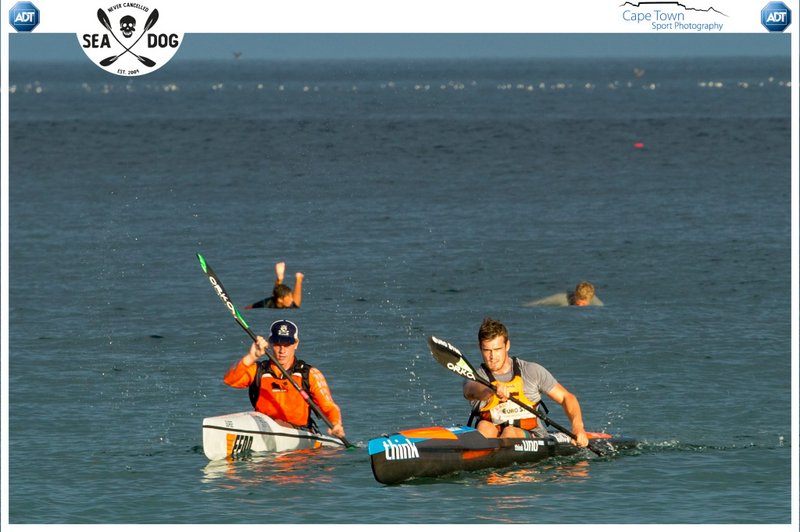
Mark Keeling dicing with Kenny Rice early in the race
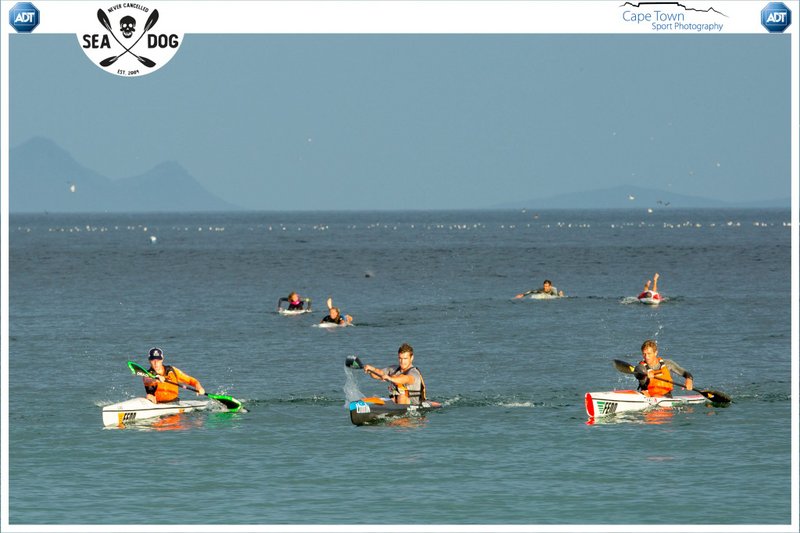
Keeling (L), Rice and Dawid Mocke charge towards the leeward buoy.
It was clear that shorter ski is agile and turns sharply.
And a close third behind Mocke and Rice clearly isn't a bad result!
Durban -The mixed doubles crew of Luke Nisbet and Jenna Ward stole the limelight at the HiQ Surfski Challenge on Friday night, as the penultimate leg of the popular FNB Surfski Series had to be modified to suit the heavy cyclone surf conditions in Durban Bay.
Additional Info
-
Content Part 2
Final Event
Race Ten, the Varsity College Surfski Challenge and Varsity College SA Schools Champs, of the 2018 FNB Surfski Series takes place at Marine Surf Lifesaving Club on Friday, 16 March.
SUMMARY OF RESULTS -HiQ SURFSKI CHALLENGE
Overall Singles
1 Matthew Bouman 29:01
2 Wade Krieger 29:30
3 Gene Prato 29:53
4 Jordon Clauson 30:54
5 Jason Graham 30:56
6 Brendon Delport 32:17
7 Michel De Rauville 32:49
8 Bridgitte Hartley 32:50
9 Lance Howarth 33:04
10 Gordon Spalding 33:07Doubles
1 Luke Nisbet/Jenna Ward 28:35
2 Brent Chiazzari/Travis Slier 28:53
3 Zoog Haynes/Matt Maroun 28:57
4 Tyron Maher/Trevor Maher 29:45
5 Trevor Verness & Skye Prato 31:49
6 Gareth Miles/Raquel Arcediano 32:03
7 Wesley Bench-Capon/Brad Alan 33:05
8 Gary Behn/Claire Behn 33:14
9 Amy Peckett / Cara Waud 36:21
10 Ken Reynolds / Dylan Botha 36:59Women
1 Bridgitte Hartley 32:50
2 Lyn Bennett 38:07
3 Sharon Armstrong 39:16Women Doubles
1 Amy Peckett / Cara Waud 36:21
Short Course
1 Connor Botha 18:21
2 Dave Rees 18:39
3 Wise Mvubu 18:50
1 Siobhan Sharp 19:30
2 Tayla Gilmore 19:51
4 Lungelo Shange 20:19
5 Minenhle Ntombela 20:34
6 Kevin Oliver 20:47
7 Allice Whiteedward 20:57
8 Waldo Bekker 21:11
9 Kenny Beukes 22:11
10 Thubelihle Banda 22:26More information can be found at www.marineseries.co.za.
"There is no good reason to use feather angle on your paddle," said Oscar Chalupsky (in his usual assertive manner.) The surfski.info forum has seen something of a debate raging on this topic in the last couple of weeks; I knew that Oscar had been encouraging beginners to use zero feather, so I called him to ask for his views.
Additional Info
-
Content Part 2
Mounting and re-mounting drills
Chalupsky also mentioned another vital brace-related skill that he teaches novice paddlers: remounting.
"The key," he said, "is to start paddling BEFORE you bring your legs into the boat." The drill that he uses is:
- Remount, bum first, with both legs over the side.
- Start paddling, bring one leg into the boat, then over the other side.
- Bring the other leg in, then move it over the other side so that both legs are out the other side.
- Then bring them both into the boat, one at a time.
The aim is to become completely comfortable with your legs over either side of the boat - and to be in control, paddling while completely stable.
"Many paddlers can only remount from one side - you have to be used to remounting from either side," he said, "if you're going to be safe in a big downwind."
Here's Oscar demonstrating the remount on a rough day in Portugal:
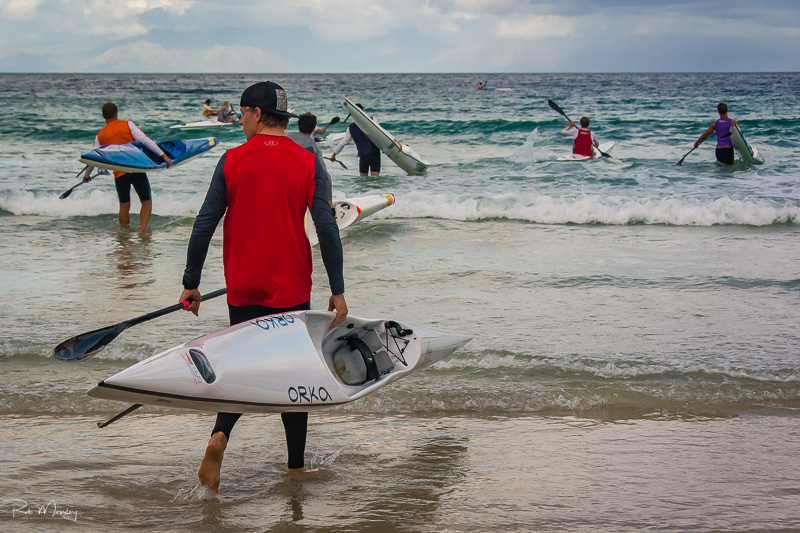
In what may be a world first... we bring you photographs of the latest Fenn surfski - the Fenn SURGE. The boat was delivered to Cape Town today; local paddler Mark Keeling was the recipient and took delivery at Fish Hoek this evening. Surfski.info was there to capture some images...
Additional Info
-
Content Part 2
But the proof of the pudding... is in the racing. Mark Keeling will be racing the boat for the first time in our Seadog Race tomorrow evening. The forecast is for flat conditions... We'll interview him after the race to get his impressions of the new boat.
Happy paddling!
Rice/MacLaren Dominate Western Cape Doubles Champs in Cape Town
Written by Rob MousleyKenny Rice and Stuart MacLaren dominated the Western Cape Double Surfski Championships in False Bay on Sunday, in perfect downwind conditions… Bianca Beavitt and Angie Austin won the Women's title.
Additional Info
-
Content Part 2
Women's Race
Bianca Beavitt and Angie Austin, the sole women's crew, came in 20th overall.
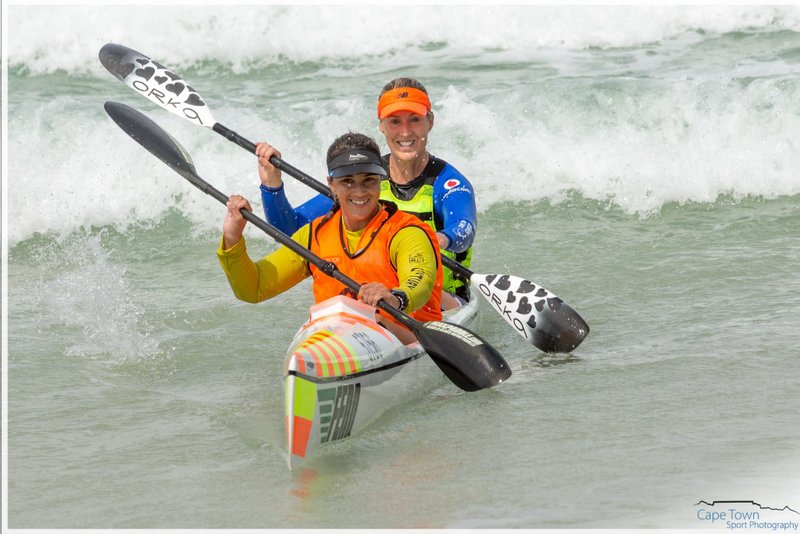
All smiles as Bianca Beavitt and Angie Austin reach the finish at Fish Hoek
"It was amazing to paddle behind Bianca," said Angie Austin. "It's unusual to be racing and yet to have so much fun at the same time. We just seemed to click together - and Bianca reads the runs so well."
"It was our first time in the boat together," said Bianca, "I swamped her a few times (and myself). It would have been nice to have slightly bigger conditions, but it was clean and we had such fun.
"As you can see in the photos, all smiles!" she added.
Thanks to the Fish Hoek Surf Lifesaving Club for hosting the event - and to the NSRI for providing safety on the water.
"We had a fabulous day out," said race director Richard Kohler. "It would be great to see more paddlers come out and support these races. It's one of the least expensive sports to take part in - and one of the most fun! What's not to like?!"
Summary Results
Click here for the full results
Men
- Kenny Rice & Stu MacLaren: 43:13.7
- Mark Keeling & Nicholas Notten (under 23): 44:36.3
- Dawid Mocke & Jono Nieman: 45:15.3
Women
- Bianca Beavitt & Angie Austin: 52:57.9
Durban - Series pacesetters Matt Bouman and Michelle Burn took home the spoils at the Vaaka Paddle Cadence Surfski Challenge on Friday night, the eighth leg of the popular FNB Surfski Series, best mastering the demands of the onshore Easterly weather conditions.
Additional Info
-
Content Part 2
Women's Race, Keenly Contested
The women's race was another keenly contested affair, with downwind ace Michelle Burn once again used her technical nous in the bumpy return leg to get away from Nicole Birkett, who is 23 weeks pregnant, on the homeward section back to Addington beach.
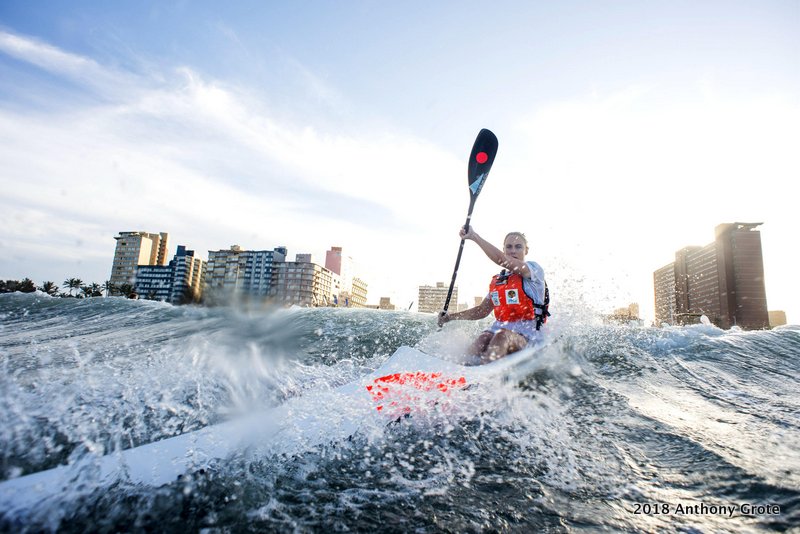
Siobhan Sharp punches through the surf at the start of the Vaaka Paddle Cadence Surfski Challenge
"I can't believe how well Nix (Birkett) is going at the moment!" enthused Burn. "I was only able to get away from her on the downwind leg.
"It was pretty hard work going into the wind," she added.
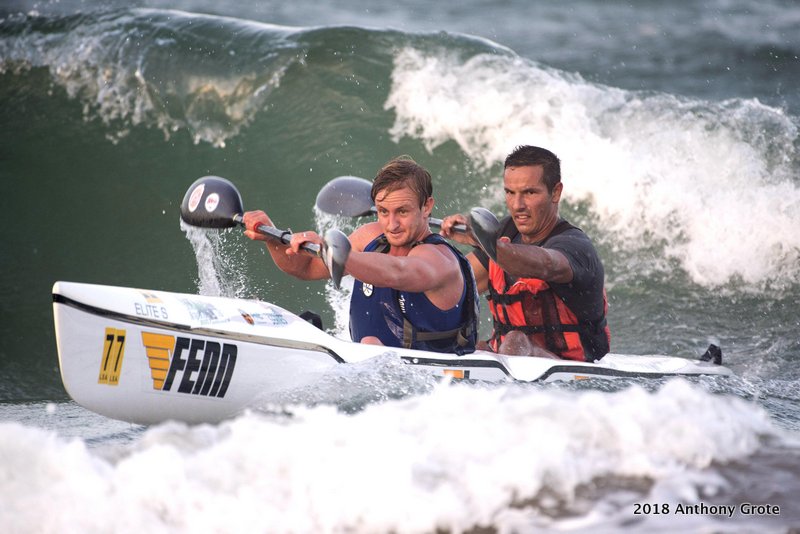
Powering away from the backline, Brent Chiazzari and Travis Slier won the men's doubles title
Jenna Ward opted to stay in the mixed double category where she has enjoyed success with Luke Nisbett, and repeated what they did last week by posting the fastest double ski time of the evening.
The short Course was won by Sanele Nxumalo from junior Connor Botha and the double ski crew of Carmel Bilson and Paige Horn.
Race Nine, the HiQ Surfski Challenge, of the 2018 FNB Surfski Series takes place at Marine Surf Lifesaving Club on Friday, 9 March.
SUMMARY OF RESULTS -VAAKA PADDLE CADENCE SURFSKI CHALLENGE
Overall Singles
1.Matthew Bouman 32.22
2.Wade Krieger 33.10
3.Gene Prato 33.37
4.Ian Black 33.56
5.Jordon Clauson 34.08Doubles
1.Luke Nisbet/Jenna Ward 33.04
2.Brent Chiazzari/Travis Slier 33.15
3.Tyron Maher/Trevor Maher 33.37
4.Donna Winter/Shaun Burgin 34.04
5.Zoog Haynes/Matt Maroun 34.08Women
1.Michelle Burn 40.07
2.Nicole Birkett 41.08
3.Sharon Armstrong 46.21Women Doubles
1.Lynn Bennett/Debbie Gillett 41.01
2.Louisa van Staaden/Wilma Deysel 44.38
3.Amy Peckett/Cara Waud 50.58Mixed Double
1.Luke Nisbet/Jenna Ward 33.04
2.Donna Winter/Shaun Burgin 34.04
3.Gareth Miles/Raquel Arcediano 38.14Short Course
Overall Singles
1.Sanele Nxumalo 21.59
2.Connor Botha 22.21
3.Carmel Bilson/Paige Horn 22.40More information can be found at www.marineseries.co.za.
Nikki Mocke wins Miller's Run of the Season Title in Cape Town
Written by Rob Mousley"That was… the best fun I've had in years," said Dawid Mocke as he watched the rest of the paddlers riding the surf into the beach. "It doesn't matter who you are, you're all in with an equal chance."
Additional Info
-
Content Part 2
Special Category Prizes
Aside from cash prizes for the fastest times by gender and age group, there were enough special category prizes that everyone was in with a chance. They included:- an Epic V10 Surfski for the best Miller's Run Video
- a smart watch and Vakaa cadence sensor for most recorded runs
- a Private Chef Date Night for four for the best mixed doubles time
- 2 x Orka paddles and 3 x Motionize systems in the lucky draws.
And Toshiba sponsored a limited-edition t-shirt for everyone who registered 20 or more Miller's Runs during the season (and as it turned out, an even-more-limited-edition shirt for the two paddlers who registered FORTY or more runs!)
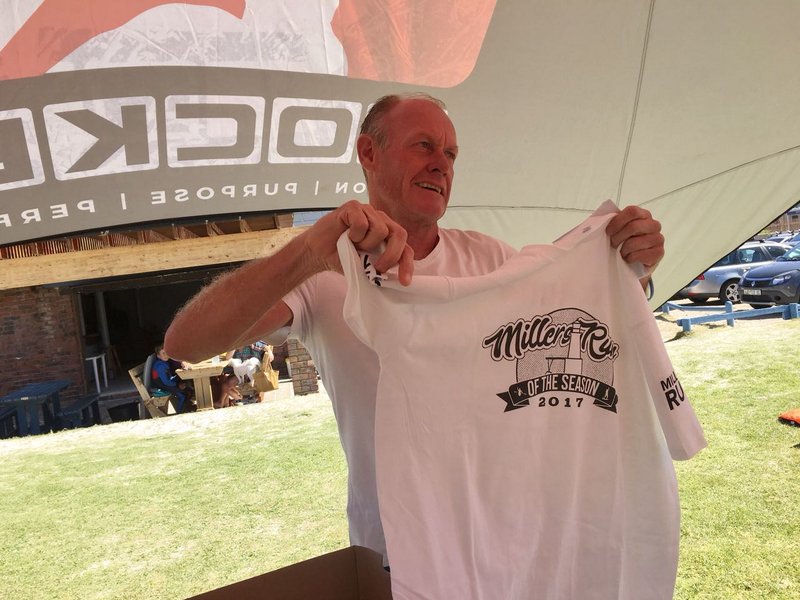
The hard-earned, limited-edition, 20-run or more shirt!
Best Miller's Video - Peter Holloway
For his innovative camera viewpoint showing the barrels of spray flying from his wave deflector, Peter Holloway won an Epic V10 Surfski.
Miller's Run
The Miller's Run is a renowned downwind route in Cape Town, South Africa.
The start of the run is marked by Bakoven Rock, a jagged outcrop 800m offshore at Miller's Point; the finish is just under 12km away at Fish Hoek Beach.
A shout-out must go to Vinnie Cicatello's Miller's Taxi shuttle service which has made the Miller's Run so much easier to do…
Results
Men
- Overall fastest: Jasper Mocke - 36:43
- Under 23: Kenny Rice - 37:25
- Over 50: Oscar Chalupsky - 38:25
- Over 60: John Blacklaws - 45:12
Women
- Overall fastest: Nikki Mocke - 45:39
- Under 23: Kirsten Flanagan - 46:28
Most Miller's Runs recorded
- Rob Mousley: 44
20+ Miller's Runs Limited Edition Shirt
- Rob Mousley: 44
- Michael MacLachlan: 42
- John Blacklaws: 26
- Peter Holloway: 25
- Ian Black: 22
- Neil McCreadie: 21
Latest Forum Topics
-
- Keep Your Essentials Safe with the 10L Dry Bag by Harry Cooper
- 5 days 16 hours ago