

Race Report: Sean Rice wins Irish Coast Paddling Champs
Written by Rob MousleyWith eight km to go, Sean Rice decided to accelerate. “There were three of us at that point and I felt I could do a burn to get rid of one of them,” he said. To his surprise, both Cory Hill and Gordan Harbrecht dropped back. But the race wasn’t over yet…
Additional Info
-
Content Part 2
Men’s Race
Having won the Nelo Summer Challenge convincingly, just two weeks before, Sean Rice was in a confident mood.
“Portugal was a test of fitness,” he said. “So, I was really happy with the win there.”
His preparation for the Irish race included travelling to the venue half a dozen times over the last few months to paddle and familiarise himself with the course. Two weeks of focussed paddle training back in London put the finishing touches on his preparation.
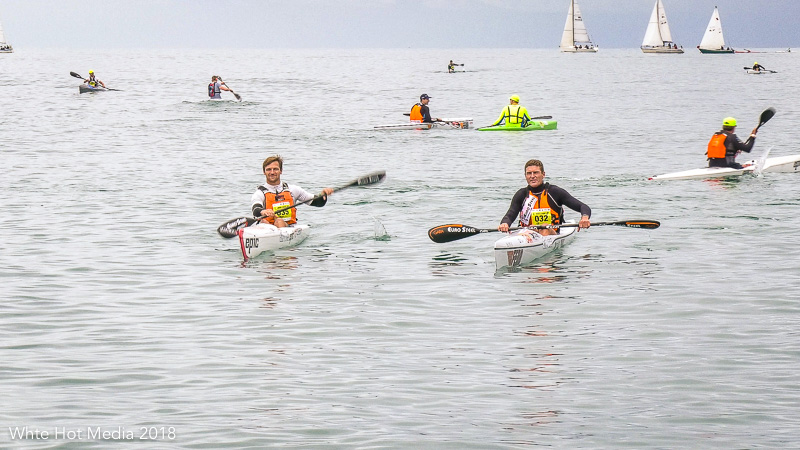 Jasper Mocke and Hank McGregor, before the start
Here we go...
When he saw the conditions on Saturday morning, current ICF Ocean Racing World Champion Cory Hill thought, “Here we go…
“We knew what we were in for,” he said. “We had pretty much the who’s who of surfski racing on the line at the start.”
The weather had thrown a curve-ball at the race; after the previous two days of howling gale-force winds, Storm Ali had moved on, leaving an almost unnatural calm in her wake.
The conditions for race? 2-4kt of breeze, a predicted swell of 10cm, sea temperature 14C and air temperature 11C! It was going to be a 22km grind…
Hotspot
The €2,000 hotspot prize meant that the pace was frantic from the start.
Sean Rice lead the way off the beach, Hank McGregor and Sean’s brother Kenny on either wave, with Cory Hill, Gordan Harbrecht and Jasper Mocke one wave back. 200m from the buoy, McGregor accelerated with Cory Hill, but Rice responded, even opening a small gap to take the €2,000 bounty.
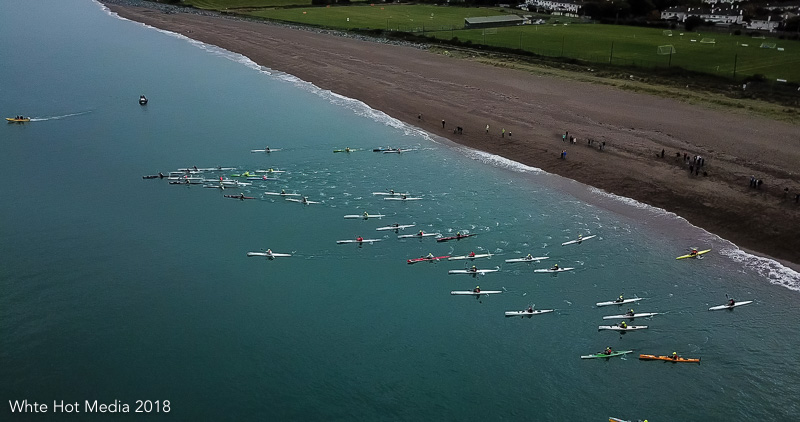
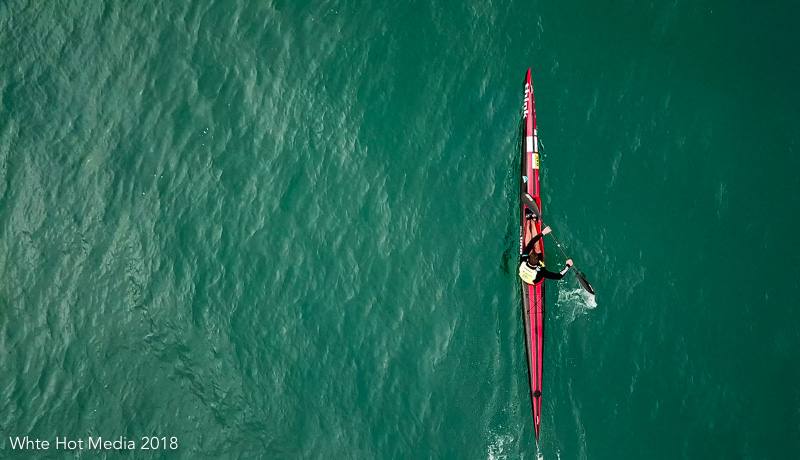
Drone's view of the start of the Men's Race
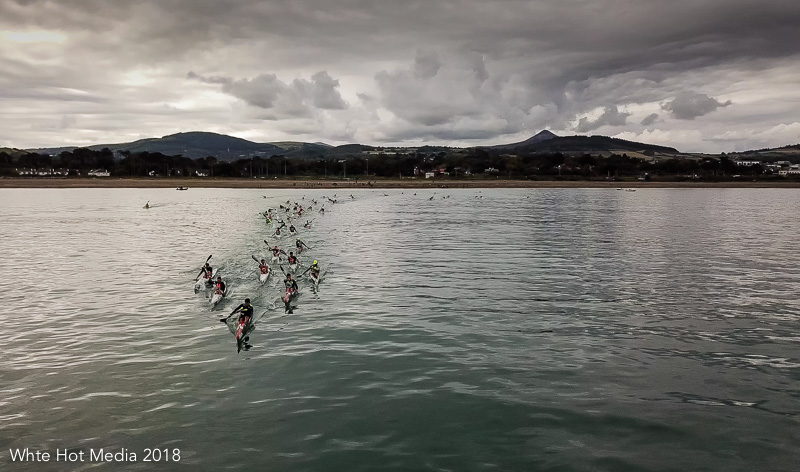
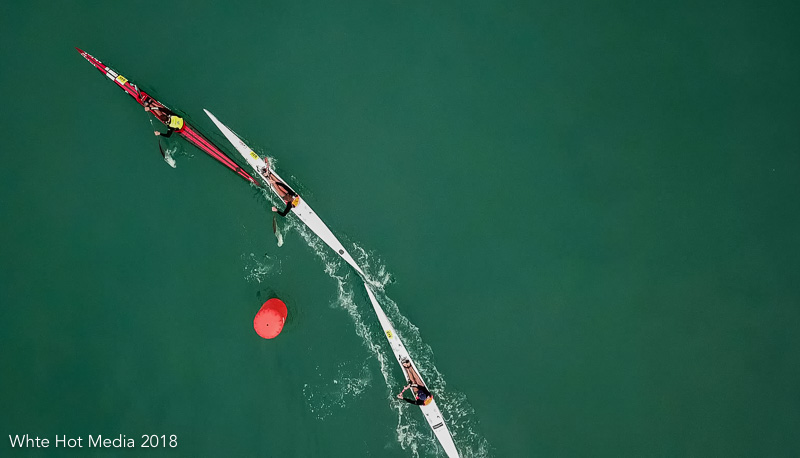
Sean Rice takes the hotspot prize
For a brief period after the turn, the seven paddlers looked set for a marathon-style wash-riding contest.
“After the turn, I did a hard km,” said Rice. “But when I looked back, everyone was still close.
“Then we went through a fleet of racing yachts and I kicked on a wave and put my head down.”
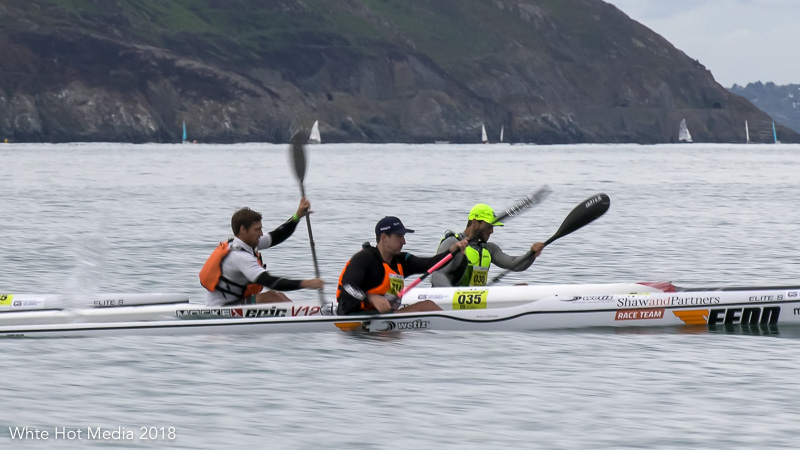
L-R: Jasper Mocke, Cory Hill and Austin Kieffer, just after the hotspot
Fracture
The group fractured, leaving McGregor, Rice, Hill and Harbrecht in the front bunch.
A few km later, Hill took up the pull. “Hank was looking comfortable, but 6km in, he left the bunch and moved further out to sea,” said Rice.
“Cory did a burn and we were moving really fast,” said Rice. McGregor dropped back and then there were three in the front bunch.
With eight kilometres to go, Rice decided to accelerate again to see if he could force one of the others to drop off the wave. To his surprise both Hill and Harbrecht dropped back.
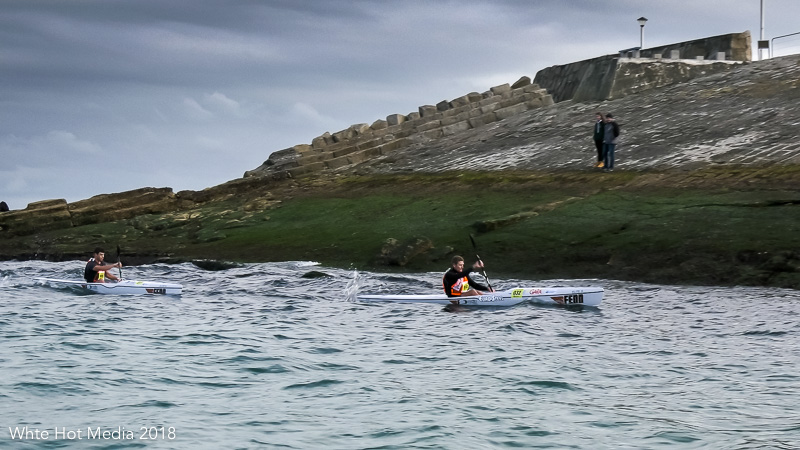
One of the stand-out performances was that of Austin Kieffer who finished in 5th, just behind Hank McGregor
When he reached the channel on the inside of Dalkey Island, Rice steered close to shore to avoid the tidal currents that he’d experienced previously on his practise runs. “But the tide was just on the turn,” he said. “I could see that Cory was keeping up, so I moved out to the middle of the channel.
“There was never a paddles-down moment,” said Rice. “But it was never totally flat either.”
The finish was inside Dun Laoghaire harbour, 500m of flat, sheltered water from the entrance.
“I wanted to get to the entrance with a slight lead,” said Rice. “I’d invested energy at the start so the last thing I wanted was a sprint finish.”
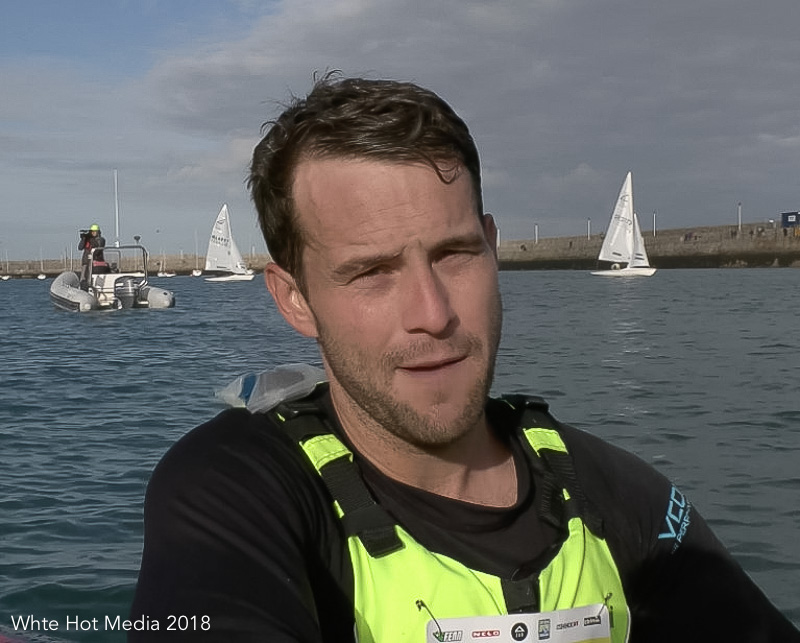
Sean Rice
In fact, Rice finished in 1:29:26, 57 seconds in front of Cory Hill; a convincing margin in the conditions.
“It’s funny that Sean was talking about doing intervals,” said Hill. “It was a sprint from the start! It’s almost embarrassing; he’s in a league of his own right now.”
Fantastic Year
“It’s been a fantastic year,” said Rice. “We had a great summer, so training has been easy and my motivation high.”
Deliberately choosing not to burn himself out at Molokai (which he won in 2017) or by doing marathon worlds this year, Rice is also enjoying living in London. “It’s been a real advantage to be back home within a couple of hours of each race,” he said.
At 29, Rice feels as though he’s “just beginning to mature.
“I’ve developed a really good instinct on my feelings and what’s happening with the boat,” he added. “Even when I lose, I know why. I train very hard, but I don’t kill myself the way I used to. I do feel that I can do this for a while longer,” he added.
In spite of being well prepared for the Irish Coast race, however, Rice said, “I was really, really nervous, to the point where I was almost feeling that the nerves and anxiety wasn’t worth it!
“Having finished the race, today I felt really cool! I got a bit of a smack at the Gorge, felt I had to change and did the change.
“I’m enjoying the ups; the downs are still mendable,” he said. “I’d go crazy if I couldn’t race in some capacity!”
He was full of praise for “Flash” Gordan Harbrecht, who came in third. “Gordan’s result isn’t a surprise,” Rice said. “But this weekend he beat some really big names – a huge result. And he’s done the hard yards, including visiting Cape Town to train…”
-
Content Part 3
Doubles Race
The doubles race was dominated by the three crews of Mocke/Smith, Medina/Viloria (Spain) and the Henot brothers (France).
“We got there a few days early,” said Dawid Mocke, “and did the course on the Tuesday before the race.
“It’s a really nice downwind course,” he said. “You can see exactly where you’re going and there are no reefs. If the surf is big, you can start from a harbour (at either end).”
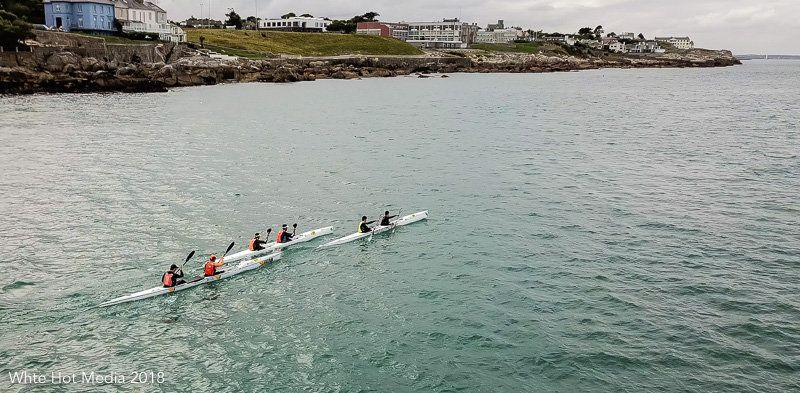
On race day, five doubles turned the hotspot buoy together, but after 2km, Mocke/Smith put in an interval and split the group, leaving the top three crews working together.
Really Strong
“The other crews were really strong,” said Mocke. “We were outgunned in terms of speed; on the intervals we were just hanging on and if it had come to a sprint finish, we’d have been third.”
But the wily Mocke was ready when the opportunity came.
“2km from the harbour, near a little bay, there was an area of refracted chop coming offshore,” he said. “I told Phil we had to go now.
“We caught a sneaky side-swell and went wide off the group,” said Mocke. The move took the others by surprise and by the time they realised what had happened, Mocke and Smith were several boat lengths ahead, and blasting for the finish.
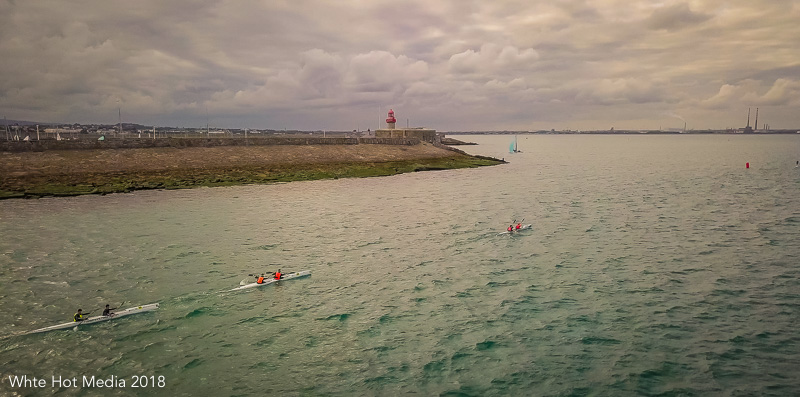
Taking the other crews by surprise, Mocke/Smith surge into the lead
“This race is definitely one for the bucket list,” said Mocke. “It’s so beautiful, it’s easy to get to the west coast, it’s full of history, the scenery is incredible…”
Amazing Event
“From a South African perspective, this is an amazing event,” said Hayley Nixon. “The video is going to be amazing, it’s one of the most picturesque races ever.
“Irish hospitality is second to none,” she added. “Incredibly generous.”
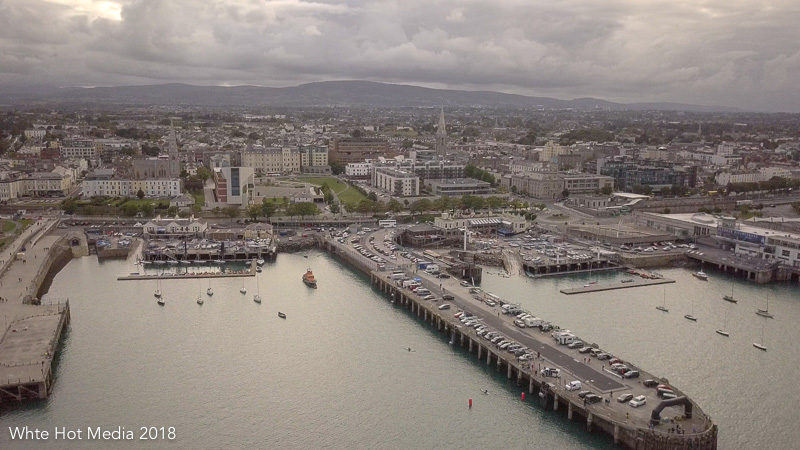
Dun Laoghaire Harbour
Dawid Mocke, paddling doubles with compatriot Phil Smith, was equally enthusiastic. “It’s a great course,” he said. “Straightforward; you can see where you’re going the whole time, there are no reefs or other surprises.
“It’s a beautiful country to visit,” he added. “The distances to the west and south coasts are relatively small so it’s very practical to tour. And South Africans don’t need a visa! Bonus!”
Results
(Click here for the full results)
Singles (men)
- Sean Rice (RSA)1:29:26
- Cory 'Chill' Hill (AUS) 1:30:23
- "Flash" Gordan Harbrecht (GER) 1:32:12
- Hank McGregor (RSA)1:32:43
- Austin Kieffer (USA) 1:32:50
- Jasper Mocke (RSA) 1:33:43

Singles (women)
- Hayley Nixon (RSA) 1:44:22
- Teneale Hatton (NZ) 1:44:59
- Bridgitte Hartley (RSA) 1:46:35
- Jenna Ward (RSA) 1:48:55
- Angie Le Roux (FRA) 1:49:30
- Rebecca Newson (GBR) 1:50:41
- Chloë Bunnett (ESP) 1:51:04

Doubles
- Dawid Mocke/ Phil Smith (RSA) 1:28:59
- Esteban Medina/ Daniel Sanchez Viloria (ESP) 1:29:10
- Valentin Henot/Hector Henot (FRA) 1:29:20
Links
Click here for the race website
Click here for the race Facebook page
Click here for Austin Kieffer's excellent blog post on the race
Downwind fiend and avid surfski videographer Sharon Armstrong does it again - and produces a video that is a Master Class in how to get through monster surf. Watch and learn!
Additional Info
-
Content Part 2
Getting In
"...those videos at the end weren't me," she said. "But I was lucky to get a clean run in after waiting for sets again but my GoPro battery was flat by then so had no footage."
In the video the paddlers exercise more restraint, avoiding the temptation to ride those swells in to the beach... Eventually, they choose their moment, let the wave roll under them and chase the back of it... It only takes about 20-40 strokes and you're past the impact zone. Easy to say, difficult to do.
The second paddler has to do it twice.
Sharon's had some practice though - this was her 80th downwind this year! The Queen of Durban Downwind!
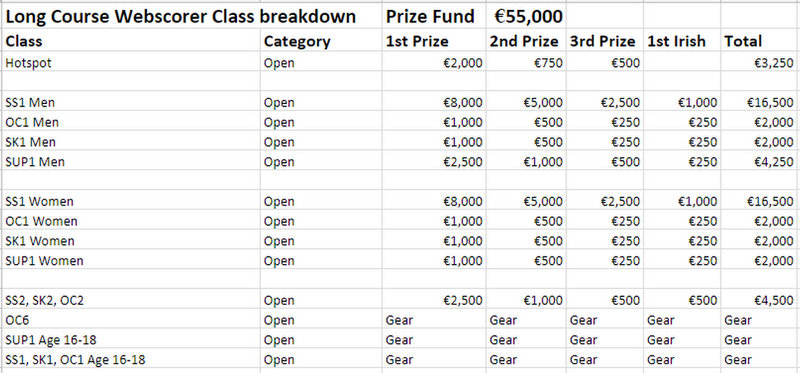
€55,000 in Prizes for Inaugural Irish Coast Paddling Championships
Written by Rob Mousley…and most of the world’s best surfski paddlers, both men and women, are in Ireland to take part. Here’s what you need to know about the world’s richest surfski race.
Additional Info
-
Content Part 2
Weather Forecast
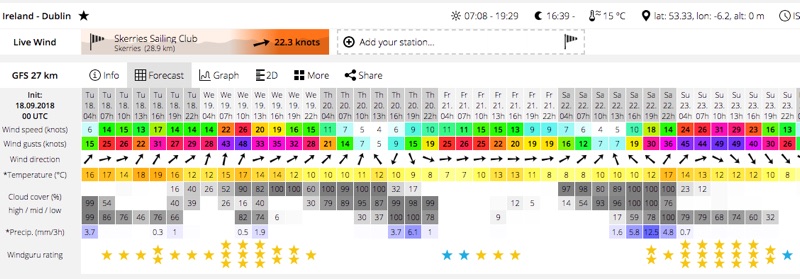
“The locals say the forecast is only worth looking at from two days out,” said Hayley Nixon. (Where have I heard that before?!)
As I write this, Storm Ali is approaching the UK and Ireland with 40-50kt gusts predicted for Wednesday morning (downwind, anyone?), but the forecast for Saturday says that the winds will be light, SW, swinging to the SE. Let’s hope the locals are correct and that the forecast changes before Saturday… (Careful what you wish for though – the forecast for Sunday is for 30-50kt westerlies!)
The Loot
The prize pot is enormous by surfski standards. If the first paddler to get to the hotspot also wins the race, they’ll walk away with €10,000, not too shabby.
Links
For more info, see the links below.
Click here for the list of confirmed entries (and results will appear here too)
[Editor: Sune Wendleboe (engineer, photographer extrarordinaire and mad keen surfski paddler) has owned no fewer than 27 surfskis in the last few years. He recently took delivery of an Epic V11 Elite and in this article shares his impressions of the sleek black paddlling machine...]
Additional Info
-
Content Part 2
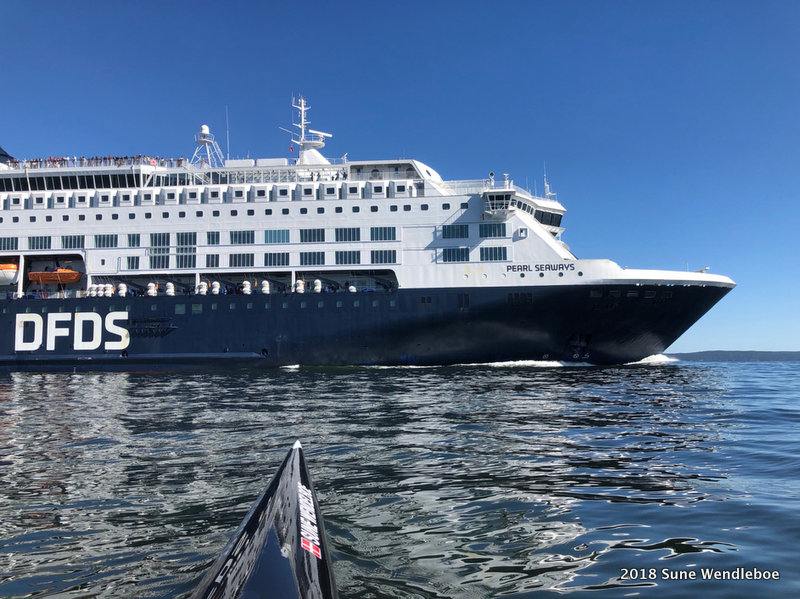
About to turn onto a ferry-boat wake
The short version is: I totally love how the boat handles. This is THE boat for me at my current level. It seems fast, I LOVE it in the short Oslo runs and the summer power boat chop – meaning 1-2-3 ft intersecting waves from all directions all summer + wind waves reflecting from steep cliffs.
Being nimble is important in our steep choppy waters, and this boat is just that! Turn, accelerate, go!
Windy Conditions
In late summer we’ve had a lot of good winds, ranging from 9-20m/s mean wind speeds. On a few occasions I’ve been surprised on the water as the wind suddenly kicked in. Normally I’d head back and opt for my Swordfish or even my V8Pro for these forecasts, but I was surprised to learn how the short V11 just sailed on. It rolls, but you get used to it, and I’ve had some fun days in it.
Comparisons
All this is a personal issue and might be little value to others, so I’ll try to compare the experience to other boats:
- The Oscar-era Nelo560 I owned was much the same, lively, fun, fast and wild but not too wild, but destroying my buttbones. Perhaps the Nelo is a bit more twitchy – but only by a few points.
- My old love the great THINK Uno Max is a paddle bus, a fast bus for sure, faster on flat and in small chop. When conditions get big I don't enjoy it as much as the V11.
- The V14 (of course) is a tad more unstable, but the biggest difference though is that it’s much more easy for me to manoeuvre the short V11 in waves – letting me catch rides and runs moments after I see them.
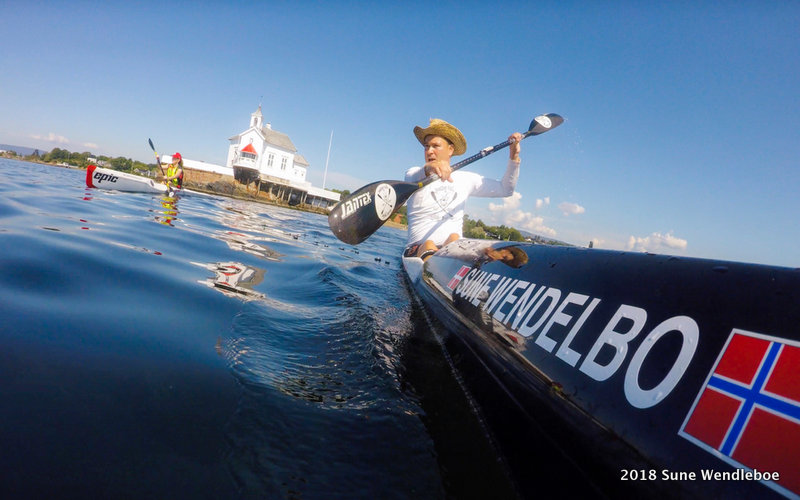
Summertime... and paddling is easy...!
Horses for Courses
We get short steep waves in Oslo. I wasn’t too fast in my V12 in Oslo, but I was very fast in my V12 when I got home to the long fast predictable runs in windswept sandy Danmark. The V11 is an Oslo / Sune boat and I love it.
In Summary
I like it so much I’ve ordered the new V10 Elite 3rd generation as well. Did that a long time ago, and sometimes I wonder if I really need it now that I’ve become one with my V11.
I’ve owned 27 surfskis, I’ve liked quite a few, fell in love with maybe two or three, but it’s the light nimble V11 that I want to paddle when I get home from work these days.
So is this useful for you? I don’t know. For reference I’m 44, started paddling at 37, at 38 Boyan told me my technique probably couldn’t get worse even if I tried, at 40 I went to Fish Hoek to paddle Millers run with Nikki Mocke in 15ft+ (figure rising every time I tell the story) swell and waves and loved/hated it. Normally though I paddle anything from flat, small runs and lighter downwinds at 10-26kt winds in Oslo and Denmark, and paddle 5 times a week for fun, fitness, friendship and sometimes for competition.
Downsides?
Yeah, but not too many. The paddle bangs against the sides of the boat now and then, and the lid on the rudder house expands in the heat and gets stuck. EPIC has informed they’ll fix that though. The hairline scratches are not pretty on a jewel like this – but inevitable.
Now that our awesome summer is ending or has ended, the autumn winds are slowly brewing and I’m looking forward to comparing the V11 to the new 3rd Gen V10 in the months to come!
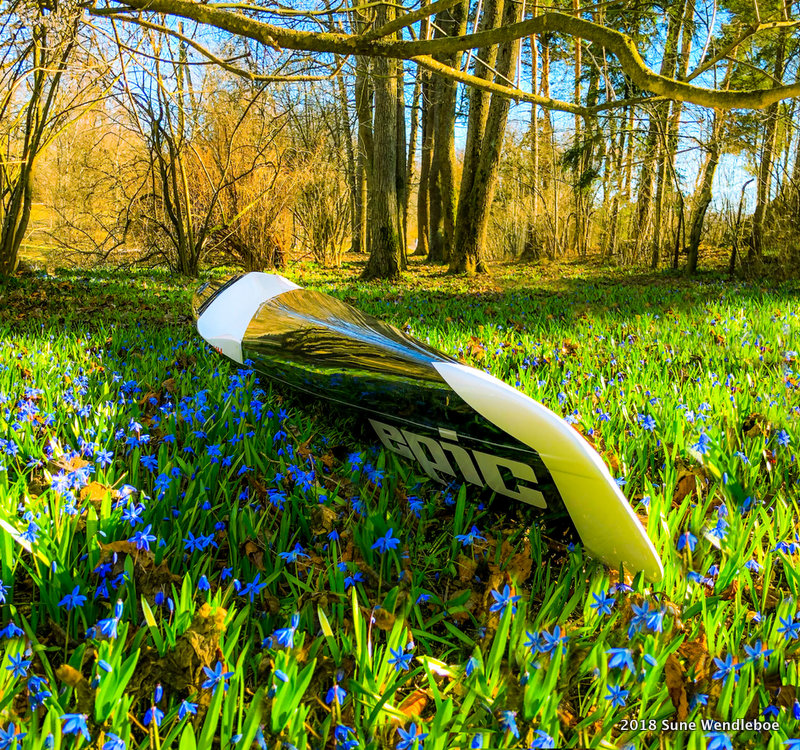
I’m not suggesting that you rush down to your dealer and buy a V11. You might be way past my skill level or you might find the ski way too much to handle. All I’m saying is that finish and construction are first rate, the ski is very light and solid. I find that it handles very well in short steep confused as well as larger runs and surfs very well. Feels rock solid on the runs and doing good upwind despite being light, although it surely doesn’t have the directional stability that my Think Uno owns.
Biggest difference being that the V11 turns on a dime making paddling downwind while picking between emerging waves very fun. Don’t know if / don't think that it’s faster than speeding on a straighter line in a V14, but you get a very satisfactory feel for the water in the V11. Haven’t tested it in fast long runs where my Think rules though. But – it’s surely an Oslo / Sune boat for now!
Sune Wendelboe, Oslo, August 2018
Sam Mayhew might have left it too late in the race to try to catch the eventual winner, Aussie Sam Djoden, but he did experience a proper adrenalin spike when a breaching orca landed right next to him… The 2018 Zest Brokers Poor Knights Crossing lived up to the paddlers’ expectations – wildlife, exquisite scenery and hard racing…
Additional Info
-
Content Part 2
Waka Ama
Kevin Jerusalamy, a highly ranked waka ama paddler from Tahiti, was locked in a titanic battle with Kaitaia’s Tupuria King from start to finish, and only managed to finish less than a minute in front to take the win in the waka ama division.
Kevin Jerusalamy
It was a brave effort from Jerusalamy who had struggled in relatively cold conditions. He and King were paddling side by side for the entire race until the last 500 metre dash to and through the archway.
Race director Tim Eves said the event had lived up to high expectations with the battle in the waka ama division particularly engaging.

Results Summary
Ocean surfski:
- Sam Djodan (Aust) 1h 51m 15s
- Simon Longdill (Akld), 1h 54m, 14s
- Sam Mayhew (Akld), 1h 54m 54s,
Waka ama:
- Kevin Jerusalamy (Tahiti), 2h 3m 12s
- Tupuria King (Kaitaia), 2h 3m 40s
- Stephen Roulton (Whangarei), 2h 4m 7s,
SUP:
- Jan Dunlop (Akld), 2h 35m 55s
- Sam Johnson (Whangarei) 2h 36m 32s
- Jonno Leonard (Akld), 2h 46m 35s
Yeeeeeha! As I accelerated down yet another small run, I thought, ‘I can definitely handle this boat’…” In fact, in the conditions I was paddling in, the DNA gave me a taste of what it feels like to be an elite paddler…
Additional Info
-
Content Part 2
The DNA – first looks
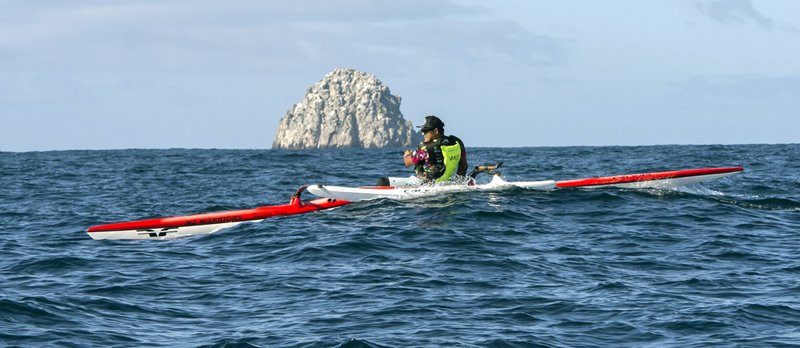
Like all of Allwave’s products, the finish on this boat is spectacular. Measurements are:
- Weight: 11kg (in carbon)
- Length: 640cm/21ft
- Width: 42.8cm/17in
While it looks similar to the CX, Roberto confirmed that the main differences are:
- Cockpit moved 7cm forward.
- Rudder moved 7cm forward.
- Raised rails (to make the cockpit drier).
- Slightly increased volume in the nose.
- Increased footwell length to cater for taller paddlers.
The rocker in the hull is unchanged.
In other respects, the DNA is the same as the CX: it has the same footplate and adjustments and you can adjust the leg length while seated in the ski. The angle of the rudder pedals is also easily adjusted using a jamming cleat mounted on the front bulkhead.
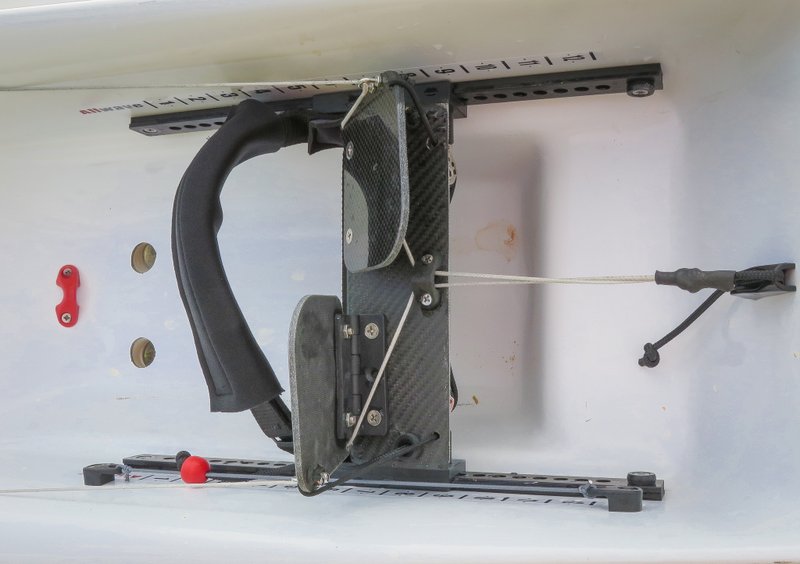
Footplate fittings
The rudder bar (beautifully machined and clearly extremely strong) is now hidden under a hatch cover and they’ve done away with the emergency steering mechanism that I so admired in the original CX.
(Roberto said that the practical problem with the system was that the bungy cord tends to lose its elasticity over time and they had complaints from paddlers who said that the system didn’t work when it was needed…
My answer to those paddlers - having used the system in a real emergency - is that they should replace the bungie regularly along with their rudder cables. This is called “annual maintenance”!)
Paddling the DNA
My first paddle was on the sea, near the ancient Roman Port of Ostia (my mind was constantly blown by the history of ancient Rome). On the way we paused for the first of many times for coffee… It seems that in Italy one cannot go for more than about 45min without a hit of caffeine!
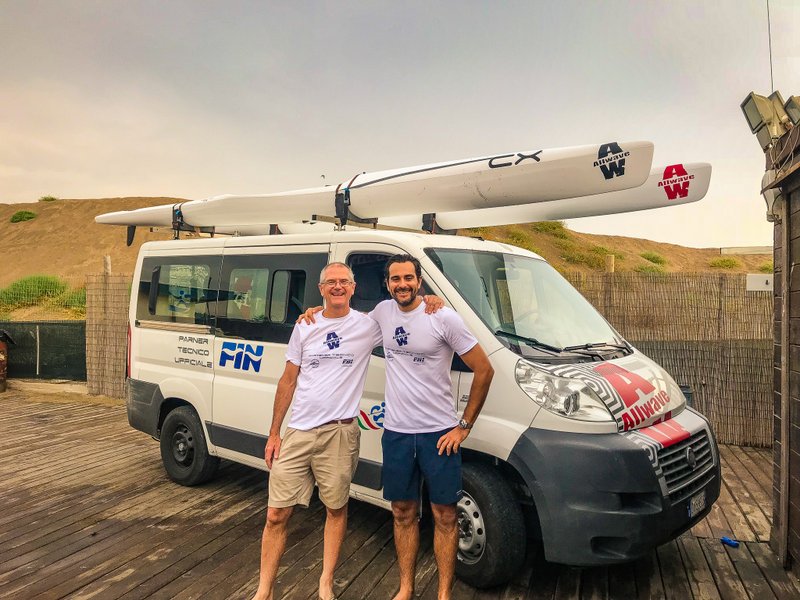
Post paddle - with Stefano Pirrello, Allwave's agent in Sydney, Australia
Conditions were perfect for the first run – a light breeze and an almost flat sea.
The DNA is a snug fit for me; plenty of room to rotate, but you’re firmly in contact with the boat.
Setup was quick, with no need for Allen Keys or other tools.
(Not having brought my own paddle, I borrowed an Orka Inner Pro, made by Orka paddles in Cape Town. I used the paddle for my entire stay and enjoyed it – it’s an easy and comfortable to use medium-size blade that plants in the water cleanly and doesn’t twist or skid in the stroke.)
Stefano (in the CX) and I did a number of ins-and-outs and my immediate observation was how fast the boat feels.
It’s more tippy than my swordfish – but that was no surprise. (As time went on, however, my feelings changed from “Nice, but I’d sweat it on a Miller’s Run” to “Oh boy, I can’t wait to try this on a Miller’s Run”…)
The sea was calm, but there were small bumps in the water. Several times as Stefano and I were paddling steadily alongside each other, I found myself catching runs and smoothly accelerating away. This was the first sign to me at rate that the boat is a surfing machine…
Back to the lake and out we went for dinner – and possibly the best fish dish I’ve ever experienced at the Ristorante Il Pioppo… oh man.
I have to digress here and mention the food. It was wonderful to stay with the Spigolis and to experience authentic Italian food… the pastas were, not surprisingly, nothing like the imitations we get back home. And in three days I put on more than a kilo in weight…
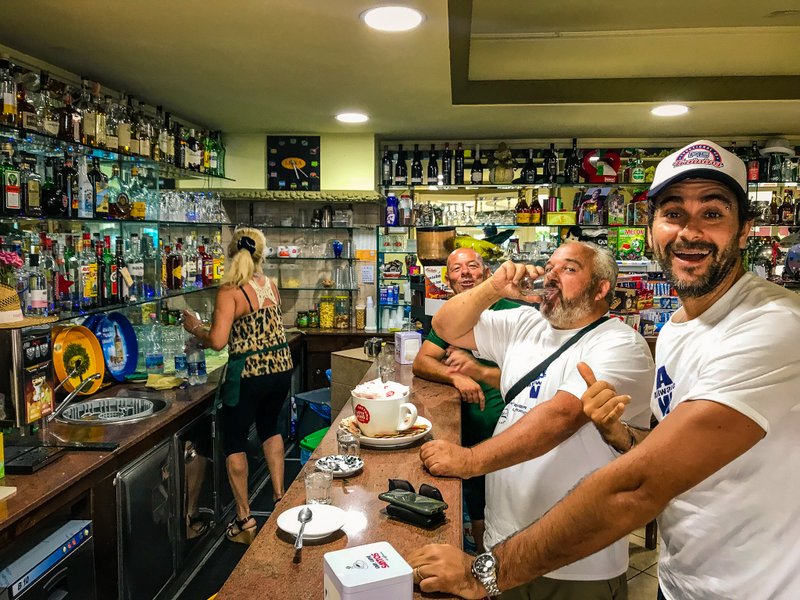
Italians seem to have an insatiable appetite for caffeine!
Flat Water
The next morning, we started with some paddling on the glassy lake…
Stefano and I did a series of intervals and even with my disreputable flat-water technique, I was maintaining around 13kph, which for me is appreciably faster than I normally achieve on the flat!
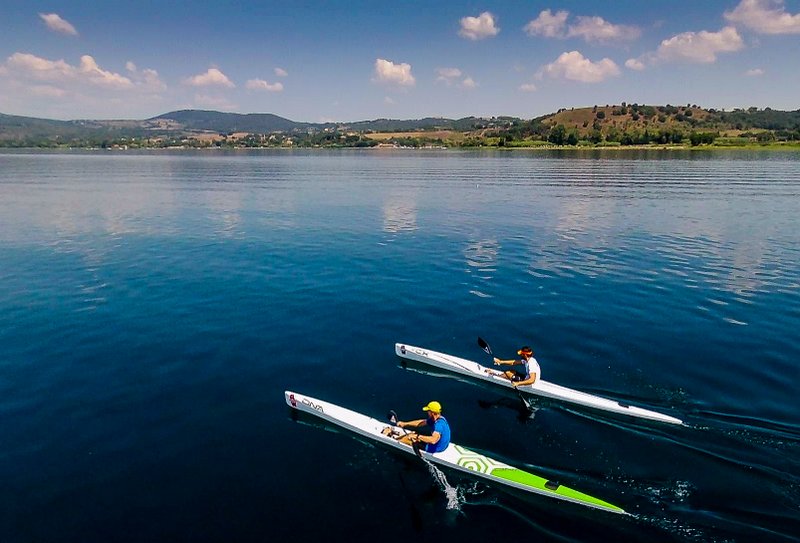
Glassy conditions on Lake Bracciano
We had just returned to shore when I noticed the Sabazia II ferry boat, the only powered vessel allowed on the lake, passing on its two-hourly circumnavigation… so of course, we headed out to ride its wake.
It was too far out, and we didn’t make it – but we were able to turn and ride the wake waves anyway and once again it was clear that the boat just loves to jump onto a wave, however small. I was riding the waves diagonally and the boat didn’t show any sign of broaching either.
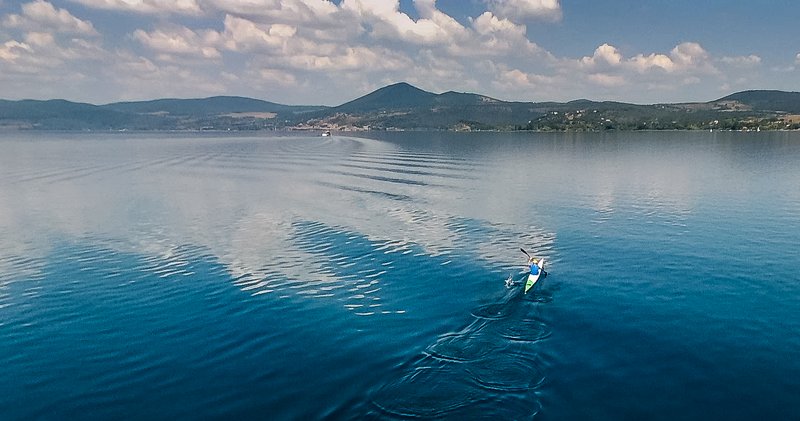
Chasing wakes
Ladispoli Downwind
Then it was time for more pasta, before we headed down to the sea again, this time to paddle from Ladispoli to Passo Oscuro with one of Roberto’s customers and friends, Emilio.
We stopped on the way for coffee (of course) and we finally figured out that what I normally drink at home is what Italians recognise as Café Latte… One drawback of ordering a latte though is that I was left behind while the others tossed their espressos down… I swear for them, it’s just a caffeine hit.
The paddle turned into a really pleasant, mellow run… It wasn’t exactly a downwind; some of the time we actually had a gentle headwind (which was a blessing in the heat) but we did have small runs the whole way, and it was enormous fun.
For me, the fundamentals of a good downwind boat include:
- A perceptible acceleration as the back of the boat lifts up and you take off onto a run – even on a very small wave
- The ability to surf diagonally down the face of a wave without losing control and broaching
- The ability to turn from a diagonal back onto the run so that you execute s-turns to stay on a wave
Clearly any boat will broach if you’re careless, but I’ve paddled boats in the past that had a clear propensity to broach and some that either had rudders too far back or that were designed badly, making them ineffective.
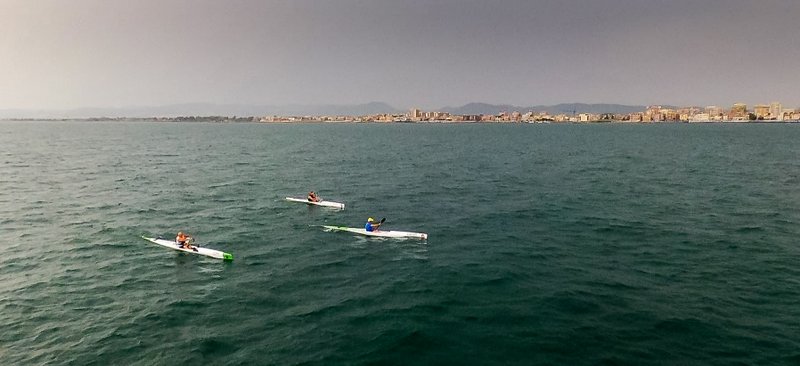
Mellow Roman downwind
The DNA is enormous fun in waves… It feels fast and feels as though it’s accelerating onto the runs and I thought it very manoeuvrable. The rudder on the one that I was paddling was a big surf rudder and it was highly effective. I could catch a run, move to one side or the other and swing the boat back.
I found myself on my own when I reached what I thought was the finish, so I paddled back into the waves to meet the other two – and realised that I was feeling extremely comfortable in the boat. Conditions weren't exactly hectic – but balance was proving not to be an issue at all.
There was another issue though – my coccyx had developed a raw area from rubbing on the back of the seat. I have an unusual backside, however and have struggled with many a seat that most paddlers have no problem with.
Back to base and a late supper before the final day of testing.
-
Content Part 3
Swapping Boats
Next morning Stefano and I did some more intervals, this time swapping between the CX and the DNA. On flat water there didn’t really seem to be much difference between the boats – hardly surprising given the hulls are very similar. When I put the hammer down, I could get the boats up above 14kph, but 100m or so of that and I'd have to back off.
The Sabazia II came chugging past again and I paddled out hard to meet her… Unfortunately (as Roberto commented knowledgably) her hull is extremely efficient and the wake waves are at an extreme angle making it virtually impossible to catch them and steer the same course as the ship… But however, we managed to stay with her for 500m or so, enjoying the 15kph waves.
Bracciano Downwind
In the afternoon the wind arrived, and we had a very pleasant, mellow downwind crossing of the lake. Once again, the boat really came alive on the bumps and again, although the chop was small, I remarked how stable I felt. Allwave are sending a couple of the boats to Cape Town next month, and I can’t wait to try the DNA in our conditions.
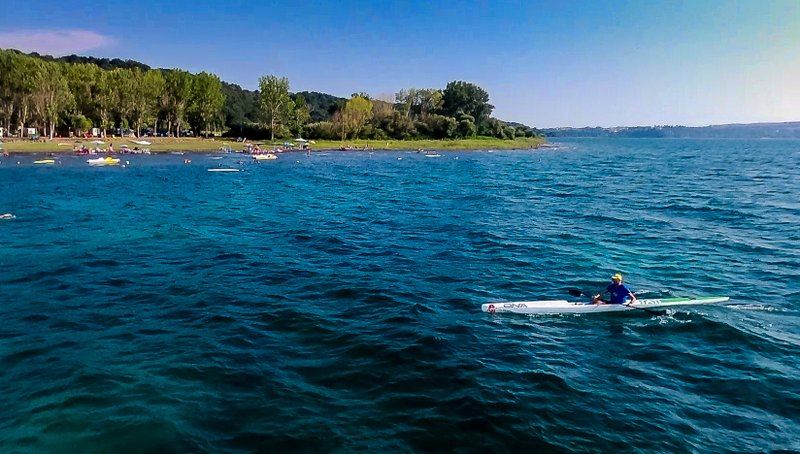
Paddles down (just) on the Bracciano downwind!
Remounting
We jumped off the boats a couple of times over the three days, sometimes to test remounting, sometimes just to cool off.
Because of the narrow seat and higher rails, I think this is a slightly more difficult boat to remount than the CX, and it’s definitely trickier than other, wider boats like my Swordfish, but it’s by no means impossible.
(At the time of writing there’s just been a tragedy in New Zealand where a paddler died after having been unable to remount his surfski in cold water. This is an absolutely critical skill that must be practised.)
Overall Impressions
In case it’s not obvious, I’m a big fan of Allwave, and the DNA in particular. We didn’t paddle in rough conditions, and I’ll be writing a follow-up piece after having paddled the boat in Cape Town, hopefully sometime in September.
The positives?
- The build quality overall – everything from the footplate controls to the tiller bar are top notch and have been thought through from a useability point of view.
- I love the way the boat behaves in small downwind conditions – and I can’t wait to try it in some bigger stuff. The more I paddled it, the more stable I felt (duh!), but I'm keen to see how I feel in our choppy waters.
Things to watch out for
- Can’t really blame the boat, as noted above, but my coccyx was rubbed properly raw after three days. Is there no standard seat out there that suits everyone?
- The higher rails and narrow seat makes this (like many of the elite-level boats) more tricky to remount than wider surfskis. Just make sure you practise remounting – no matter what boat you have.
And yes, Roberto and Mario, I think the DNA name is just fine!!
For more information, click here to go to the Allwave website
Durban – With their sights firmly set on the upcoming World Marathon Champs K2 title, the crew of Hank McGregor and Andy Birkett delivered a masterclass to claim the two-day 43km Gara Dolphin Coast Challenge title on Sunday.
Additional Info
-
Content Part 2
Results Summary
Overall
Position Crew Day 1 Day 2 Total Time 1 Andy Birkett/Hank McGregor 01:20:46.99 01:11:57.86 02:32:44.86 2 Luke Nisbet/Gene Prato 01:22:42.73 01:15:48.11 02:38:30.84 3 Herman Chalupsky/Colin Simpkins 01:28:55.54 01:20:00.62 02:48:56.16 4 Zoog Haynes/Lance Howarth 01:30:51.52 01:18:44.27 02:49:35.79 5 Quinton Rutherford/Malcolm Carey 01:30:29.53 01:23:00.63 02:53:30.16 6 Brett Hadiaris/Ross Fountain 01:34:55.61 01:19:55.82 02:54:51.43 7 Tyron Maher/Clinton Cook 01:26:21.04 01:29:20.70 02:55:41.74 8 Oliver Burn/Matt Gunning 01:36:38.82 01:22:53.34 02:59:32.16 9 Michel De Rauville/Luke Symons 01:33:42.97 01:27:26.34 03:01:09.31 10 Steve Cohen/Brad Pearse 01:39:48.74 01:28:13.07 03:08:01.81 11 Stretch Struwig/Mike Stevens 01:42:08.55 01:26:33.72 03:08:42.28 12 Greg Worthington/Justin Wenke 01:43:03.58 01:26:55.38 03:09:58.96 13 Heinrich Van Rooyen/Theo Smit 01:39:26.40 01:30:50.30 03:10:16.70 14 Shadrack Mkhize/Craig Webster 01:41:24.92 01:29:34.18 03:10:59.11 15 Billy Harker/Rex McGregor 01:42:23.40 01:29:48.29 03:12:11.69 16 Dirk Barnard/Juan Maree 01:41:58.30 01:31:26.84 03:13:25.14 17 Dave Harker/Marc Descoins 01:42:14.16 01:32:00.43 03:14:14.59 18 Anton Fouche/Linton Hope 01:41:10.81 01:33:45.64 03:14:56.45 19 Travis Wilkinson/Ross Poacher 01:44:33.50 01:31:15.17 03:15:48.68 20 Hayley Nixon/Christie Mackenzie 01:45:31.62 01:30:31.81 03:16:03.43 Women
Position Crew Day 1 Day 2 Total Time 1 Hayley Nixon/Christie Mackenzie 01:45:31.62 01:30:31.81 03:16:03.43 2 Nikki Birkett/Sabina Lawrie 01:47:22.20 01:37:03.86 03:24:26.06 Single Skis
Position Crew Day 1 Day 2 Total Time 1 Malcolm Pitt 01:44:18.86 01:30:55.80 03:15:14.66 2 Lee Furby 01:46:27.48 01:29:29.09 03:15:56.57 3 Guy Collyer 02:00:40.79 01:47:04.88 03:47:45.67 4 Craig Thompson 02:01:01.50 01:47:35.68 03:48:37.19 5 Vernon O'Connell 02:09:52.35 01:48:43.23 03:58:35.58 6 Ray Van Der Poll 02:05:31.72 01:53:18.55 03:58:50.27
Last year we posted an article about the "Revo Foil", a project being undertaken by Revo Kayaks to create a foiling surfski. At the time it was clear that much R&D work remained to be done... but with today's announcement on durbansurfski.com, its clear that Revo has made progress.
Additional Info
-
Content Part 2
I can't wait to see the boat paddled onto a wave...
What do you think? Comment on the story below.
No more head-mount videos please! Well, at least let's mix it up a little... Head mount point of view is all very well, but I used to have a rear-deck mounted camera mast which gave a sensational perspective. But having switched boats to the Swordfish S, the mast base wasn't compatible and I've been planning for ages to build a new one. Here it is - the Mousley camera mast hack.
Additional Info
-
Content Part 2
Challenges
Mounting a camera higher above the deck presents some challenges:
- As the ski tilts from side to side, the horizon tilts with it. But most of the time, the really interesting footage is when you’re on a run and the side to side motion is usually less…
- When the camera is mounted close to the deck, the lens is automatically washed quite frequently so that there isn’t a build-up of water droplets. Not so with the mast. But so far, going downwind, this hasn’t been much of a problem and for the future I have plans for running a thin pipe up the mast so that I can squirt water over the lens by squeezing a kayak pump in the cockpit… there’s always something!
- Does the mast affect the handling of the boat? The new mast complete with camera weighs in at 600g (just over 1lb). If you're a racing snake, you won't want this dangling off the back of the boat, but it really doesn't make much difference to me, nor does it appreciably affect the tippiness of the boat either.
Testing
A couple of days ago we had a gentle northwester and I tried the mast on a mellow Reverse Miller's Run...
I will get install some self-adhesive velcro to increase the stability of the base, but this time I simply used duct tape. I added a safety line in case the duct tape failed...
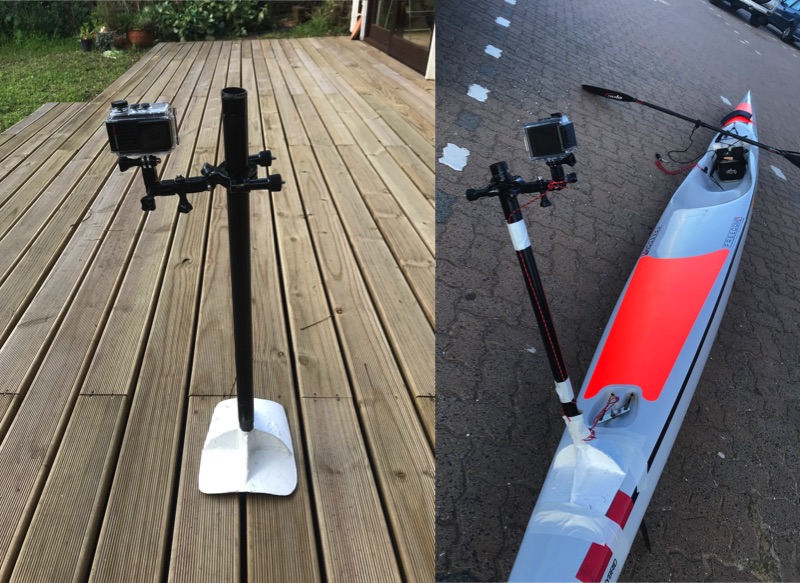
Ready to go!
And here's a short clip of the end result. Can't wait for a day when it's really cooking!
For more information
So... to reiterate: if I can do it, you can do it – go forth and build masts! It’s a fun way to add a different perspective to your paddling videos.
Here's just one of many sources of "how to" information: https://www.wikihow.com/Fiberglass
The Miller's Run in Cape Town is deservedly one of the best known downind routes in the world... But it's on the "Reverse Buffels" run where we get to play in 40-50kt howling blasts of wind and spray. On Saturday, 23 June, 2018, we had everything - wildlife, rainbows, endless 20kph runs, gale-force blasts in "Hurricane Alley"... and even a cameo appearance by the Kenny Rice!
Additional Info
-
Content Part 2
Postscript - Rescue
A few hours later, a paddler on a reverse Miller's came off and injured himself trying to remount his ski just south of Roman Rock lighthouse. Fortunately he had pencil flares and popped a series of them, which were spotted by the NSRI's Coast Watch team who'd been alerted by the paddler's companions who'd realised that he was in trouble. Click here for the full story.
Takeaways:
- Anyone can injure themselves; it doesn't matter if you're the best paddler in the world - if you can't paddle, you're in deep manure.
- Pencil flares work. If this paddler hadn't had them with him, he'd potentially have been in very deep trouble since he was being blown offshore.
- SafeTRX would have helped. If SafeTRX is available where you paddle (and it's in most of Europe, in South Africa and in Australia), do yourself a favour and install and use it. (Don't rely on it solely of course - always use a combination of safety procedures, starting with fitness and competence appropriate to the conditions.)
Thank you NSRI!
Latest Forum Topics
-
- Keep Your Essentials Safe with the 10L Dry Bag by Harry Cooper
- 5 days 20 hours ago