
- Posts: 98
- Thank you received: 20
FreeFeather Paddle
- gcziko
- Topic Author
- Visitor
1 year 2 months ago - 1 year 2 months ago #41291
by gcziko
FreeFeather Paddle was created by gcziko
My son Paul and I have developed a new type of kayak paddle that I have been using for over a year now to paddle my Nelo surfski in Los Angeles.
You can see here a two-minute video of Boyan Zlaterez paddling it in Tarifa (Spain) in varied ocean conditions (mostly downwind).
Each of the five clips included in the video provides a clue about how this paddle is different from other kayak paddles. The last short clip gives it away.
No equipment or paddle settings were changed across the five video clips.
If people find this of interest, I can provide more information about the advantages I have experienced with the FreeFeather paddle, as well as some potential drawbacks.
You can see here a two-minute video of Boyan Zlaterez paddling it in Tarifa (Spain) in varied ocean conditions (mostly downwind).
Each of the five clips included in the video provides a clue about how this paddle is different from other kayak paddles. The last short clip gives it away.
No equipment or paddle settings were changed across the five video clips.
If people find this of interest, I can provide more information about the advantages I have experienced with the FreeFeather paddle, as well as some potential drawbacks.
Last edit: 1 year 2 months ago by gcziko. Reason: removed duplicate signature info
Please Log in or Create an account to join the conversation.
1 year 2 months ago #41292
by CrabStick
CrabStick, Perth Western Australia
Current Boats: Epic V9 ultra, Fenn Swordfish S, NK Rapido
Previous: Think Eze, Stellar SR, Carbonology Boost LV, Fenn BlueFin S, Fenn Spark S
Replied by CrabStick on topic FreeFeather Paddle
Definitely interesting Gary. Is there any ratchet or is it rotating freely (between set limits?) with the front hand alone needing to control feather ?
CrabStick, Perth Western Australia
Current Boats: Epic V9 ultra, Fenn Swordfish S, NK Rapido
Previous: Think Eze, Stellar SR, Carbonology Boost LV, Fenn BlueFin S, Fenn Spark S
Please Log in or Create an account to join the conversation.
- gcziko
- Topic Author
- Visitor
1 year 2 months ago #41293
by gcziko
Replied by gcziko on topic FreeFeather Paddle
Thanks for you interest in the FreeFeather kayak paddle, Crabstick.
No ratchet. Super low friction. But limit set to 90° top-hand feather because there is never any reason to go beyond that. So 90° can be used in a headwind as shown in the first photo here, and also zero feather possible when using the blades as "sails" in a strong downwind as shown in the second photo.
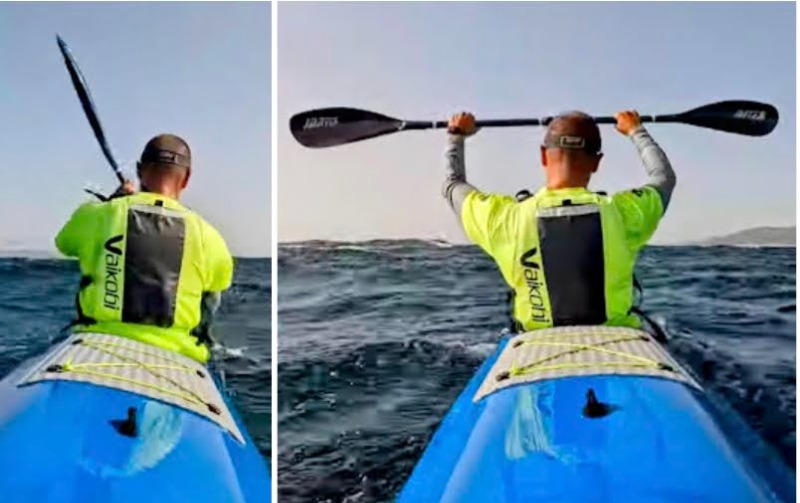
Would you like to another thing that the FreeFeather can do that no other kayak paddle can?
--Gary
No ratchet. Super low friction. But limit set to 90° top-hand feather because there is never any reason to go beyond that. So 90° can be used in a headwind as shown in the first photo here, and also zero feather possible when using the blades as "sails" in a strong downwind as shown in the second photo.
Would you like to another thing that the FreeFeather can do that no other kayak paddle can?
--Gary
Attachments:
Please Log in or Create an account to join the conversation.
- ccchappell
-

- Offline
- Senior Member
Less
More
- Posts: 69
- Thank you received: 26
1 year 2 months ago #41298
by ccchappell
BracaSport USA Importer
FastPaddler.com
Replied by ccchappell on topic FreeFeather Paddle
Hi Gary
Interesting...cool to see some new innovations. I am curious if you have had a chance to try with new paddlers in the early stage of learning to use a wing paddle? Wondering if could help, or hinder, folks who have no predetermined feather angle??
Also, is it possible to see if folks max feather angle changes with cadence? Not sure if you have ability to measure, but always wondered if a paddler would have a different optimal feather angle say at 70spm vs 110spm for their stroke?
Thanks
Chris
Interesting...cool to see some new innovations. I am curious if you have had a chance to try with new paddlers in the early stage of learning to use a wing paddle? Wondering if could help, or hinder, folks who have no predetermined feather angle??
Also, is it possible to see if folks max feather angle changes with cadence? Not sure if you have ability to measure, but always wondered if a paddler would have a different optimal feather angle say at 70spm vs 110spm for their stroke?
Thanks
Chris
BracaSport USA Importer
FastPaddler.com
Please Log in or Create an account to join the conversation.
- LaPerouseBay
- Offline
- Platinum Member
Less
More
- Posts: 354
- Thank you received: 131
1 year 2 months ago #41300
by LaPerouseBay
downwind dilettante
Replied by LaPerouseBay on topic FreeFeather Paddle
Interesting topic. Gary's account is blocked. I exchanged a few emails with him, suggesting ideas to help him get back on the forum.
I unlocked the shaft for a short time - in calm water.
My angle didn't change - probably due to muscle memory. The water outside the small harbor had some waves, so I locked it up and went surfing.
I remember my favorite coach telling me that the top hand is vital to the control of the blade throughout the stroke.
Boyan's swordfish video shows a solid grip on the top hand - especially when things get sketchy. I see him subtly flexing and extending his wrist while doing a hard brace to steer the boat.
I'm not on Facebook - but I found this thread from a year ago. (Google lets me read them, if I am careful with the prompts). They were talking about feather angles.
Jerome suggested the 'free feather' concept.
Ivan responded. I copy/pasted it below:
Jerome Truran
Holding each blade at optimal angle with each hand, and having the shaft freely rotate in the middle would solve all problems, if one could get used to it
1y
Ivan Lawler
Jerome Truran I’ve been down this road. What I didn’t realise though is that the top hand has a lot to say about the stability of the bottom blade and makes adjustments continually. With the middle joint loose you lose this control.
What you need is a loose joint in the air time that solidifies once the paddle is in the water. The closest we got to that was an interlocking cone.
1y
Jerome Truran
Ivan Lawler The upper hand still controls the angle of the shaft, while the lower hand controls the blade.. I think one could get used to it.
And please expand on your interlocking cone concept.. sounds interesting
1y
Ivan Lawler
Jerome Truran no. It turns out the upper hand has a lot of influence on the blade also. You need a direct and solid connection between the two.
One cone sits inside the other, both with non slip surfaces. In air time there is no force squeezing them together so they allow rotation. During water time, downward pressure squeezes the two cones together and “locks” the joint.
I unlocked the shaft for a short time - in calm water.
My angle didn't change - probably due to muscle memory. The water outside the small harbor had some waves, so I locked it up and went surfing.
I remember my favorite coach telling me that the top hand is vital to the control of the blade throughout the stroke.
Boyan's swordfish video shows a solid grip on the top hand - especially when things get sketchy. I see him subtly flexing and extending his wrist while doing a hard brace to steer the boat.
I'm not on Facebook - but I found this thread from a year ago. (Google lets me read them, if I am careful with the prompts). They were talking about feather angles.
Jerome suggested the 'free feather' concept.
Ivan responded. I copy/pasted it below:
Jerome Truran
Holding each blade at optimal angle with each hand, and having the shaft freely rotate in the middle would solve all problems, if one could get used to it
1y
Ivan Lawler
Jerome Truran I’ve been down this road. What I didn’t realise though is that the top hand has a lot to say about the stability of the bottom blade and makes adjustments continually. With the middle joint loose you lose this control.
What you need is a loose joint in the air time that solidifies once the paddle is in the water. The closest we got to that was an interlocking cone.
1y
Jerome Truran
Ivan Lawler The upper hand still controls the angle of the shaft, while the lower hand controls the blade.. I think one could get used to it.
And please expand on your interlocking cone concept.. sounds interesting
1y
Ivan Lawler
Jerome Truran no. It turns out the upper hand has a lot of influence on the blade also. You need a direct and solid connection between the two.
One cone sits inside the other, both with non slip surfaces. In air time there is no force squeezing them together so they allow rotation. During water time, downward pressure squeezes the two cones together and “locks” the joint.
downwind dilettante
Please Log in or Create an account to join the conversation.
1 year 1 month ago #41305
by mrcharly
Replied by mrcharly on topic FreeFeather Paddle
I read about this idea of Gary's on fb.
I suspect it would be ok for some calm water paddling, but a nightmare for anything rough, or when trying to execute tight turns (eg when racing on narrow waterways and you have to turn at a buoy).
For both stern braces and support in the water, you need control over the blade-shaft angle. Changing the direction of the stroke (e.g. going out sideways, or in a curve) can pull you back upright or prevent a broach on a wave.
If the blade can freely rotate, even by 10 degrees, you wouldn't have that control.
As Ivan says, you need the shaft/blade to 'lock' during a stroke.
I suspect it would be ok for some calm water paddling, but a nightmare for anything rough, or when trying to execute tight turns (eg when racing on narrow waterways and you have to turn at a buoy).
For both stern braces and support in the water, you need control over the blade-shaft angle. Changing the direction of the stroke (e.g. going out sideways, or in a curve) can pull you back upright or prevent a broach on a wave.
If the blade can freely rotate, even by 10 degrees, you wouldn't have that control.
As Ivan says, you need the shaft/blade to 'lock' during a stroke.
Please Log in or Create an account to join the conversation.
- LaPerouseBay
- Offline
- Platinum Member
Less
More
- Posts: 354
- Thank you received: 131
1 year 1 month ago #41306
by LaPerouseBay
downwind dilettante
Replied by LaPerouseBay on topic FreeFeather Paddle
Here is a PhD in sport mechanics spelling out the importance of the top hand as it moves thru the stroke.
Starts at 6:22.
"The arms are doing a different job within this triangle to manage these two vectors."
"While the pulling arm propels the boat, applying an effort straight backwards, the top hand manages the efficiency of the work of the blade in the water."
"The top hand plays a crucial role ... creating ... a lever to propel the boat - It has ... full control of the blade's trajectory, angles, speed of movement and the length of the lever."
A good analogy is riding a bicycle. Seems easy after some practice, but try to describe it...
Both legs are connected thru the bottom bracket axle.
Rotating the pedals and balancing involves a lot of coordination between the feet at the pedals.
Sound familiar?
Back when I was in cycling, a split axle was available.
It was used along with power meters to identify imbalances in leg strength.
I never used one, but the pros said they were incredibly tough to pedal smoothly.
Speaking of power meters, Gary should get one.
The Kiwis developed it years ago for the Olympics. They still sell them.
onegiantleap.co.nz/
Starts at 6:22.
"The arms are doing a different job within this triangle to manage these two vectors."
"While the pulling arm propels the boat, applying an effort straight backwards, the top hand manages the efficiency of the work of the blade in the water."
"The top hand plays a crucial role ... creating ... a lever to propel the boat - It has ... full control of the blade's trajectory, angles, speed of movement and the length of the lever."
A good analogy is riding a bicycle. Seems easy after some practice, but try to describe it...
Both legs are connected thru the bottom bracket axle.
Rotating the pedals and balancing involves a lot of coordination between the feet at the pedals.
Sound familiar?
Back when I was in cycling, a split axle was available.
It was used along with power meters to identify imbalances in leg strength.
I never used one, but the pros said they were incredibly tough to pedal smoothly.
Speaking of power meters, Gary should get one.
The Kiwis developed it years ago for the Olympics. They still sell them.
onegiantleap.co.nz/
downwind dilettante
Please Log in or Create an account to join the conversation.