

Durban, South Africa - An uncharacteristic Tuesday night start due to the FNB Dusi Canoe Marathon saw paddlers don pink from top to toe at the Lettie Surfski Challenge, all in support of the fight against cancer for race six of the 2018 FNB Surfski Series.
Additional Info
-
Content Part 2
Race seven of the 2018 FNB Surfski Series takes place on Friday, 23 February at the Borland Surfski Challenge presented by Marriott.
SUMMARY OF RESULTS - LETTIE SURFSKI CHALLENGE
Overall Singles
1.Matt Bouman 33:29
2.Wade Krieger 35:28
3.Luke Nisbet 35:50
4.Lee McGregor 35:50
5.Hamish Lovemore 36:31Doubles
1.Dawid Mocké/Ian Black 33:29
2.Richard Lowe/Shaun Burgin 34:06
3.Brent Chiazzari/Travis Kruger 34:10
4.Dave Harker/Justin Swart 36:48
5.Hayley Nixon/Carmel Bilson 36:55Women
1.Sabina Lawrie 41:15
2.Raquel Arcediano 45:37
3.Thea van der Westhuizen 47:40Women Doubles
1.Hayley Nixon/Carmel Bilson 36:55
2.Jacqui Boyd/Lyn Bennett 42:04Mixed Double
1.Louisa van Staden/Gavin Botha 39:51
2.Tamryn Mckie/Calvin Mckie 41:37
3.Sharon Armstrong/Carl Elkington 42:02Short Course
Overall Singles
1.Peter Jacobs 19:55
2.Connor Botha 23:04
3.Keaton Riddle 23:31Doubles
1.Kyeta Purchase/Josh Simpkins 19:57
2.Jody Taylor/Duane Taylor 20:00
3.Tyler Wilson/Garnett Wilson 21:41SUP
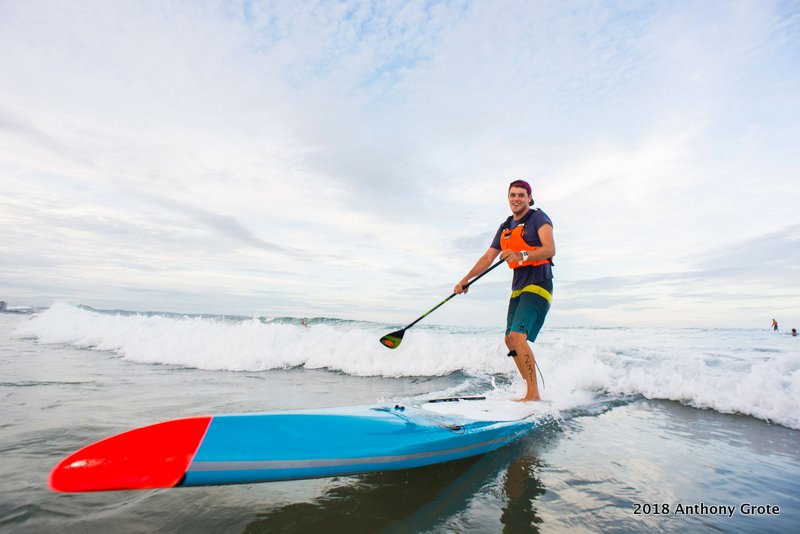
Dylan Fick, SA SUP Champion
Overall
1.Dylan Fick 28:26
2.Brandon Read 28:59
3.Nick Park-Ross 29:22
4.Shayne Chipps 29:25
5.Charlotte Atherton 31:35More information can be found at www.marineseries.co.za.
Ze Caribbean Race - Oscar Chalupsky Interview
Written by Rob Mousley"Fortunately the camera died for the last 5km, because I was cursing..." said Oscar Chalupsky. "It was flat, hot, headwind… and I was blown!"
Additional Info
-
Content Part 2
You often talk about changing the length of your paddle?
About 20min into the race, I realised my paddle was too long and went from 2.17 down to 2.15. As I got tired I changed it another two times, down to 2.13 and finally to 2.11.
You need to think of your paddle length like gears on a bike. As you get tired, you "change down".
I practise changing paddle length every day.
You can hear a voice in the background on the video?
Yes, I use Endomondo on my iPhone: it talks to me and it's great to get the splits after every kilometre so that I can judge how I'm doing.
I also use two Garmins:
- Garmin Fenix 3: I have speed, distance, time and HR displayed.
- Garmin Forerunner 920XT: Shows direction and distance to the finish.
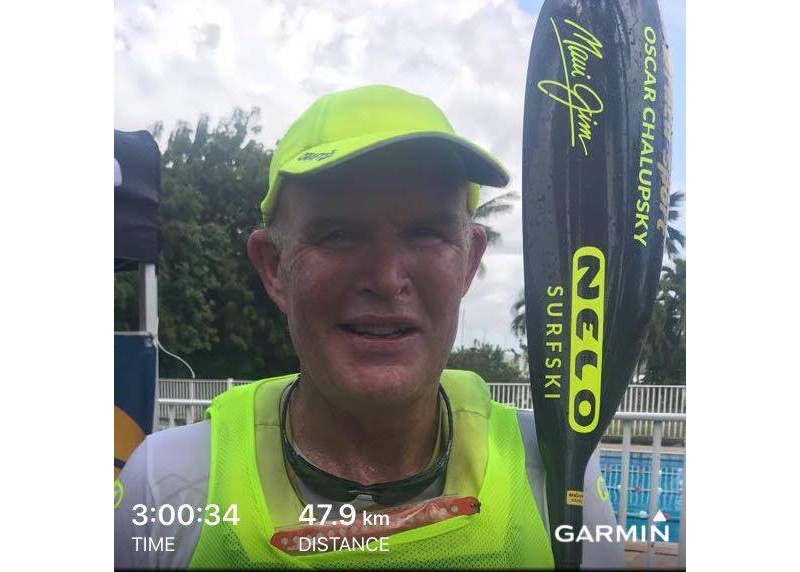
Bucket List
Oscar was full of praise for the race organisation and the venue - it's relatively inexpensive to get there and to stay there, while the paddling conditions sound sublime.
Yet another race to add to the bucket list!
Click here for the event website
Click here for the event's Facebook pageClick here for Oscar's Garmin track.
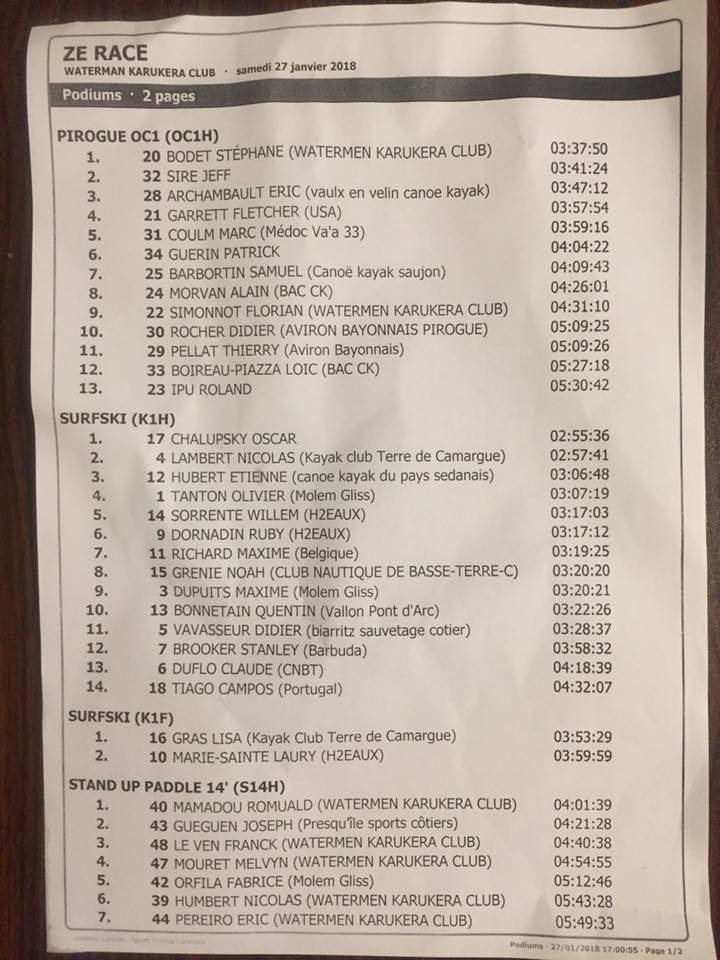
Results
"It was an adrenalin rush and I can't wait to do it again…" said Vinnie Cicatello. He'd just completed his first ever Miller's Run, in the back of a double surfski with Oscar Chalupsky.
Additional Info
-
Content Part 2
Miller's Run
The BMD is a challenge - but Vinnie's current paddling goal is do a Miller's Run in a single ski.
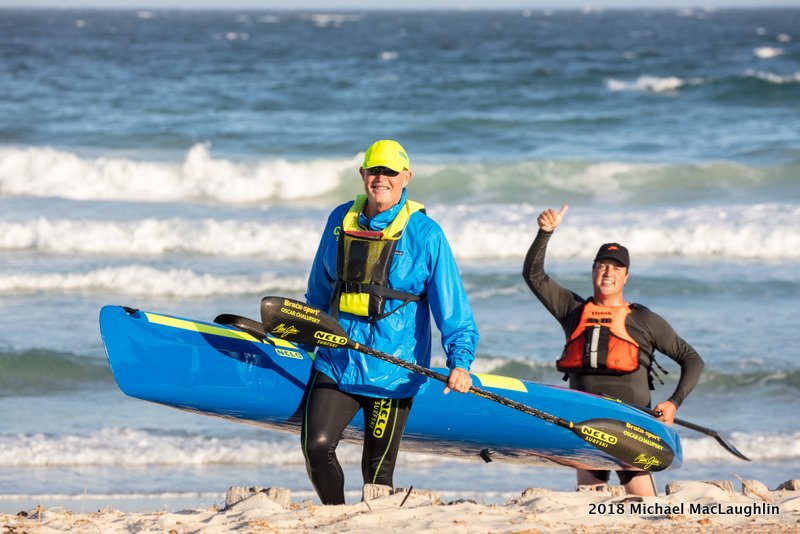
He's working steadily towards that goal, but when Nelo Surfskis CEO (and all-round surfski paddling legend) Oscar Chalupsky was in Cape Town recently, he offered to take Vinnie on a double to do a Miller's Run; Vinnie leaped at the opportunity…
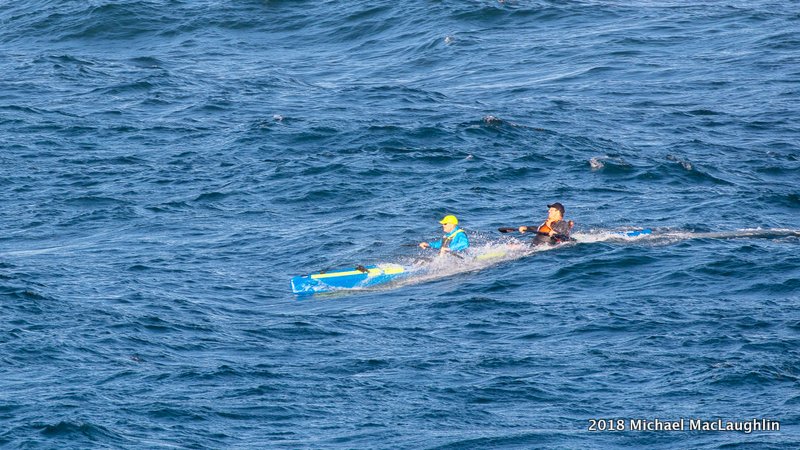 Oscar Chalupsky and Vinnie Cicatello - charging into Fish Hoek Bay
It was a "proper" Miller's Run day - 30kt of southeaster with some robust swell to catch.
"It was definitely one of my highlights of paddling especially going past Roman Rock Lighthouse at speed," said Vinnie. "It was an adrenaline rush and I can't wait to do it again…"
Post-Miller's Stoke!
WhatsApp...
Vinnie uses WhatsApp to run the Miller's Taxi side of business; times are usually announced a day or two in advance - and, obviously, depend on the weather. "In summer I sometimes do 3 or even 4 runs," he says. The taxi operates in winter too, when the prevailing wind swings from SE to NW.
To get on the WhatsApp group, contact Vinnie at +27 83 500 5194
As I shot down the face of the run, spray flying, I spotted the next dip in the water over to one side. A touch of the rudder pedal, a slight lean and the surfski turned towards it; through the dip and a neat curve in the other direction and I'd shot around the shoulder of the wave, accelerating again onto the next run. A crazy thought ricocheted around my brain: What was it that produced this feeling of extreme pleasure? Adrenalin? Endorphins? Dopamine? All three? Whatever it was, the feeling of playing with a new boat definitely added to it.
Additional Info
-
Content Part 2
Confirmation - Bum Pad Required
Having caught a cold, I wasn't at my best for the next paddle, which took me 5km out from Fish Hoek into a 15-20kt SE to the lighthouse and back. The outward-bound leg was a grind - but the stability of the ski meant that I could develop a steady rhythm, grinding it out into the waves. On the way back, the short, steep swells were a blast. I'd take a few strokes and then sit there, swooping down the runs, round the shoulders, back and forth - what a pleasure.
But I confirmed my developing suspicion that I wasn't going to get away without doing something about the bucket. The bottom, rear of the seat was definitely painful against my coccyx area and although I'd waterproofed my skin again with Vaseline to prevent chafing, it still felt rubbed and bruised - particularly because of the rotation and effort I was putting into paddling into wind.
So… the final pimping of the ski: I installed a bum pad, being sure to position it so that the notch was under my coccyx.
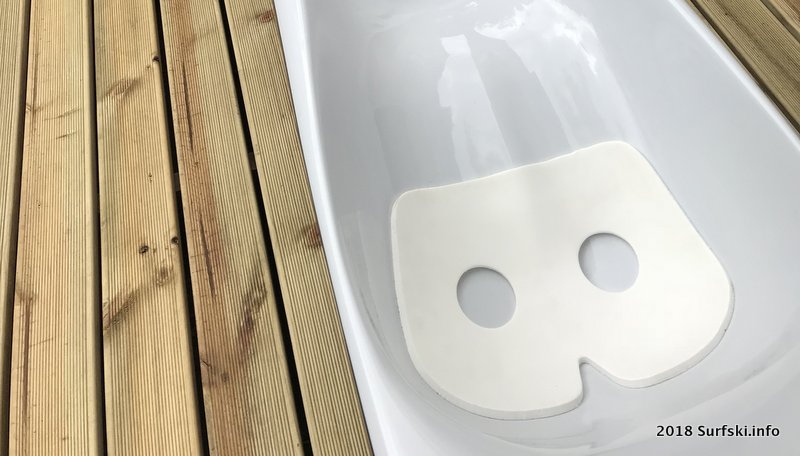
The final step - a bum pad (correctly installed with the notch to the rear).
And that was what I tested on Saturday and Sunday, on two more Miller's Runs…
Big, Sloppy Miller's
On Saturday (moderate wind, big swell) I found the conditions frustrating, requiring a lot of effort to get onto the big, sloppy runs and I found myself out of breath, heart racing and my arms feeling like spaghetti. Realising that I'm not in the peak of health right now I backed off and focussed on simply trying to paddle efficiently without letting my heart rate get too high.
In spite of throttling back, I still did a sub-48min run, a perfectly adequate time and one I'd have been thrilled with a few years ago.
Fast, Mellow, Miller's
On Sunday, although the wind was still moderate (20-26kt), the sea had a completely different character: small, clean, fast runs, with seemingly endless opportunities to link sequences. I had resolved to take it easy, given my cold, but two buddies were pushing it just in front, and the red mists came down… We ended up coming into Fish Hoek together and hit the beach within seconds of each other, glorious! Time: 46:06, excellent (for me) in the circumstances.
Best of all, the bum-pad made all the difference to my posterior comfort and I think the ski is now properly set up.
In Summary
My (current) feelings:
- It seems to me that the Swordfish S has the manoeuvrability of a short surfski (reminding me of the Nelo 520) but without a short ski's tendency to bury its nose.
- It's a slightly wetter ride than the Think Evo II, but it doesn't show any real propensity to nose-dive, and the wave deflector is extremely effective at keeping the cockpit dry.
- I find it very stable, perceptibly more stable than the Evo II.
- I can't wait to try it out in a race... (other than the Miller's Run, which almost always turns into a race in any case!)
All I need now to is to kick this damn cold… hopefully by Tuesday so that I can test myself and the ski in our regular Tuesday Series race in Hout Bay. The forecast says that it's going to be flat. Not my favourite conditions, but ideal to get an idea of the flat-water speed compared to my regular marks.
Stay tuned!
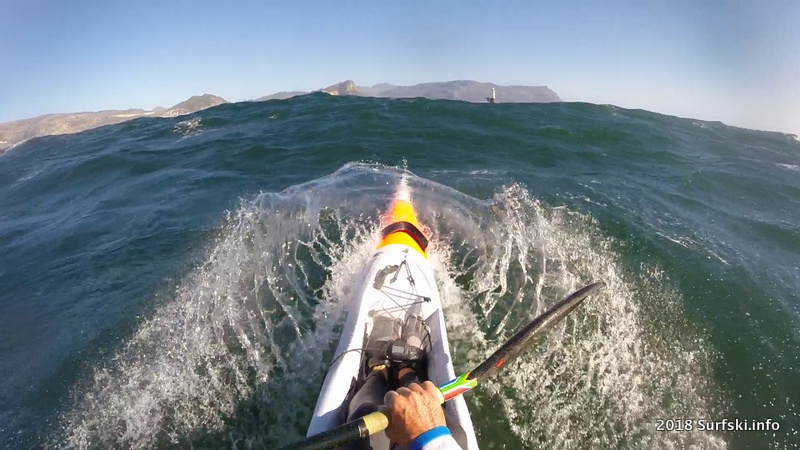
The Nelo wave-deflector squirts the water off the deck efficiently
Likes and Dislikes
What I like about the ski:
- Superb finish
- Solid-feeling footplate
- Its inclination to surf
- The manoeuvrability, which helps when linking runs and which I'm sure is going to be an advantage in round-the-cans racing
- Its immunity to side-on wind/diagonal head winds.
- The all-round stability. Whereas big, windy conditions would give me pause on the Evo II, I feel rock-solid in the Swordfish and I'm looking forward to having a crack at my PB the next time we have a proper gale.
What I like less:
- The seat: other paddlers have reported the same issue with lower rear part of the seat impacting on their coccyx. A bum-pad sorts this out.
- The cutaway at the back of the bucket. It's not terrible, but one aspect of the Nelo bucket that I really like is the comfort when leaning back (e.g. on a big run to keep the nose up).
Modifications
What I've done to the ski:
- Added footplate and pedal non-slip rubber pads (supplied by Orka).
- Added a lanyard to the bung so it doesn't get lost.
- Installed an Orka-made elliptical rudder.
- Installed an Orka-made weed deflector
- Added hi-viz neon orange stickers to nose, foredeck and aft-deck. (Highly recommended for safety reasons when paddling offshore.) Stickers supplied by Orka.
- Removed the cover over the tiller bar/rudder post so that I can see what's happening corrosion-wise to the rudder lines.
- Duct-taped a Nelo wave-deflector to the foredeck.
- Installed a bum-pad to cure the discomfort of the seat.
Durban - An incredibly strong wind from the south west provided tough conditions for all paddlers on Friday evening at Race Four, the Thule Surfski Challenge, of the 2018 FNB Surfski Series.
Additional Info
-
Content Part 2
Lee McGregor
Despite claiming the Grand Masters age category prize, Lee McGregor showed many of the younger paddlers how strong he still is by finishing in an astounding fourth overall.
"What age is Lee? Well into his 60's? I've never ever seen anything like that before!
"To come fourth overall is incredible!" Bouman added.
The Durban surfski community continues to support the series despite the difficult conditions that have been experienced over the past few weeks, something that Bouman loves about their paddling group.
"The people that make up the Durban surfski community are awesome!
"It's great to see people still coming out and racing even though the conditions were tough."
Taking third in the singles showdown was Gene Prato with Lee McGregor and William Wood finishing fourth and fifth.
With a second in the doubles last week, the pair of Travis Kruger and Brent Chiazzari went one better to claim the doubles win with Tyron and Trevor Maher finishing just behind them in second and the mixed pair of Tamryn and Calvin Mckie in third.
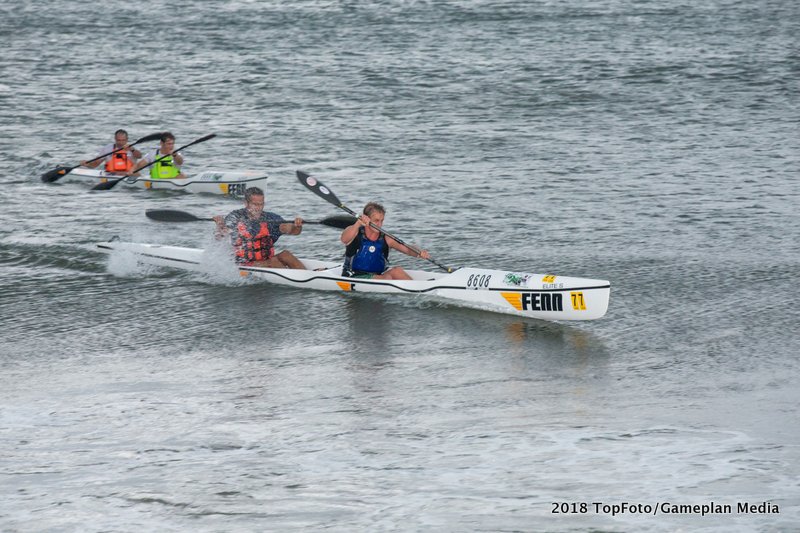
Travis Kruger and Brent Chiazzari; strongest doubles crew again...
Women's Race
Lyn Bennett was the only lady to brave the long course and she finished in just over 42 minutes.
The mixed crew of Nic Horn and Sasha Corris-Nadangen were the winners of the short course ahead of the single of Siobhan Sharp and Kenny Beukes in third.
Race five of the 2018 FNB Surfski Series takes place on Friday, 9 February at the Gara Surfski Challenge.
SUMMARY OF RESULTS - THULE SURFSKI CHALLENGE
Overall Singles
- Matt Bouman 30:08
- Wade Krieger 31:12
- Gene Prato 31:31
- Lee McGregor 32:19
- William Wood 32:31
Doubles
- Travis Kruger/Brent Chiazzari 30:49
- Tyron Maher/Trevor Maher 30:57
- Tamryn Mckie/Calvin Mckie 35:25
Women
- Lyn Bennett 42:13
SHORT COURSE
Overall
- Nic Horn/Sasha Corris-Nadengen 22:58
- Siobhan Sharp 23:46
- Kenny Beukes 24:36
Women
- Siobhan Sharp 23:46
More information can be found at www.marineseries.co.za.
Until recently I thought Freya Hoffmeister, with her 27,000km multi-year voyage around South America held the record for the longest trip ever. Not so!
Vanity Fair just published a remarkable story about Oskar Speck, who in 1932, paddled away from the bleak prospects of a Great Depression wracked Germany down the Danube River. Seven years and 30,000 miles later, he arrived in Australia, just in time to be interned as a enemy alien at the outbreak of the Second World War.
Additional Info
-
Content Part 2
Oskar Speck
Oskar Speck's voyage was somewhat different - for starters, his craft was a folding kayak: a skeleton of wooden ribs covered in rubberized material. Secondly he had no idea at the start that he was going to paddle all the way to Australia; his ultimate destination only became clear when he was far into his voyage.
But there's a paragraph in the Vanity Fair story that struck a chord:
"One of the frustrations of trying to define Speck is that he was, by his own admission, a terrible diarist. He was not a keen observer. He seemed constitutionally incapable of serious self-examination, and wrote almost nothing about his inner thoughts. There are signs of wry humor, anger, sadness, depression, elation, pure nerve, and obvious fearlessness in his writings. There are virtually none of intellectual curiosity. He seemed to have no take on himself and none on the world either."
Freya Hoffmeister, although a prolific blogger - she carries a laptop with her and goes to enormous lengths to post daily updates - is much the same. Joe Glickman told me how he struggled to describe Hoffmeister: she refused to admit fear (although she was clearly freaked out - as anyone with half a brain cell would be - by the salt water crocodiles on the Northern Australian coastline); she had little knowledge and less interest in the extraordinary history of some of the places she stopped at.
Most of Freya's writing too is one-dimensional. She describes the wind and waves, the conditions at her camping sites, her irritation with almost anyone she comes across and she describes near catastrophic mishaps (such as when she was trapped on a small island near Cape Horn for days in terrible weather) unemotionally and you can tell virtually nothing of her feelings.
At any rate, the Vanity Fair story on Oskar Speck, although not as long as Glicker's Fearless, is a fascinating and worthwhile read.
Click here to to reach the article on the Vanity Fair website.
"Why go all the way to Guadeloupe?" I asked Nelo Surfski CEO Oscar Chalupsky. "We sold a lot of skis there," he replied, "and it's a lot warmer than Porto!" Oscar Chalupsky leaves his home Portugal on Saturday to fly, via Paris, to the Caribbean to take part in one of the longest downwind races in the world, Ze Race in Guadeloupe.
And I suspect it's the "downwind" part that's the deciding factor that's attracting him there!
Additional Info
-
Content Part 2
Ze Race - course
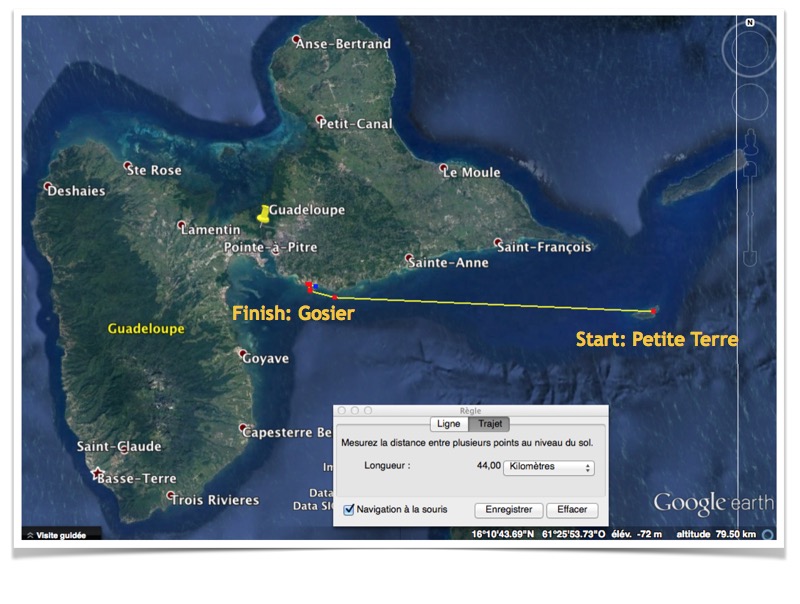
If you draw a straight line from Petite Terre to Gosier, Google Earth measures around 45km, but factor in deviations off the straight line and most competitors do about 50km, making this one of the longest downwind races in the world.
Conditions are usually "clean and big," said Chalupsky. "Like Durban - or Hawaii". Like Hawaii too, the temperatures are high - with air and sea temperatures both around the 27C mark. So good hydration is critical.
The race takes place on 27 January, 2018. Watch the facebook page for links to live tracking.
As he followed Jasper Mocke inside the rocks at Cape Point, 22-year-old Kenny Rice glanced back, looking for race favourite and defending champion Hank McGregor. He was nowhere to be seen. “Game on!” Rice thought to himself. “Hurt the guys NOW!”
Additional Info
-
Content Part 2
Women’s Race
For newly crowned ICF Ocean Paddling World Champion Hayley Nixon, back in South Africa after a triumphant 6-week overseas tour, the race was a pleasure from start to finish. “I loved every stroke,” she said.
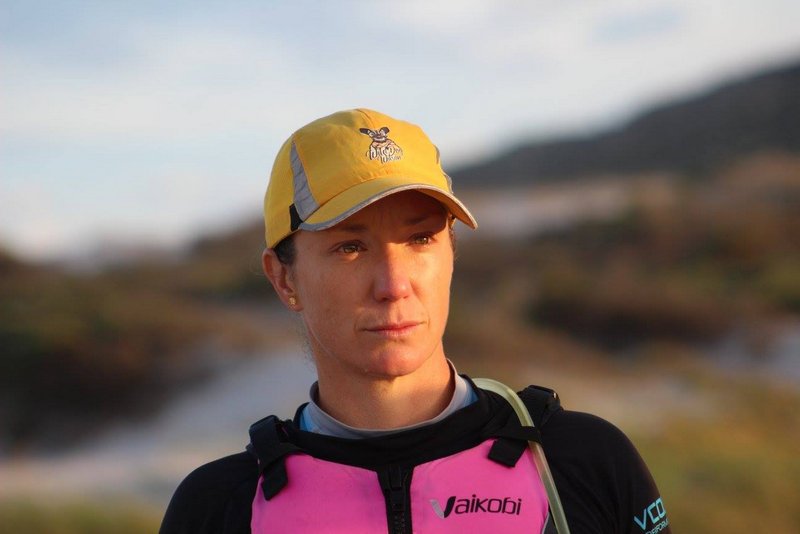
Hayley Nixon - all focus before the start (Pic: Romy Parker)
“The launch was easy, which was a huge pleasure. Last year there was a bit of a shore break, but this year we didn’t even get our hair wet!”
Her plan was to paddle conservatively for the first half and then, “paddle my seventh 25km race in the last six weeks…!”
The top women started with a mixed bunch. “The guys started out quite hard at 11-12kph, which was a bit fast into the wind but fortunately they slowed down to a steady 10.7kph average.”
Split Group
The fast start though had split the group, and although Nixon was aware that Bianca Beavitt was close behind, Kyeta Purchase and Bridgitte Hartley were nowhere to be seen until…
“After about 20km, we hit the kelp beds,” said Nixon, “I suddenly saw a group on a line inside the kelp – and there were Bridgitte and Kyeta.”
Nixon moved across to join the other two women as they made their way through the kelp. “Bridgitte was really strong,” Nixon said. “I stayed on her tail and focussed on paddling efficiently.”
Neither of the women was familiar with the area at the base of the cliffs at Cape Point and after a brief discussion, they agreed to take a line around the outside of the rocks.
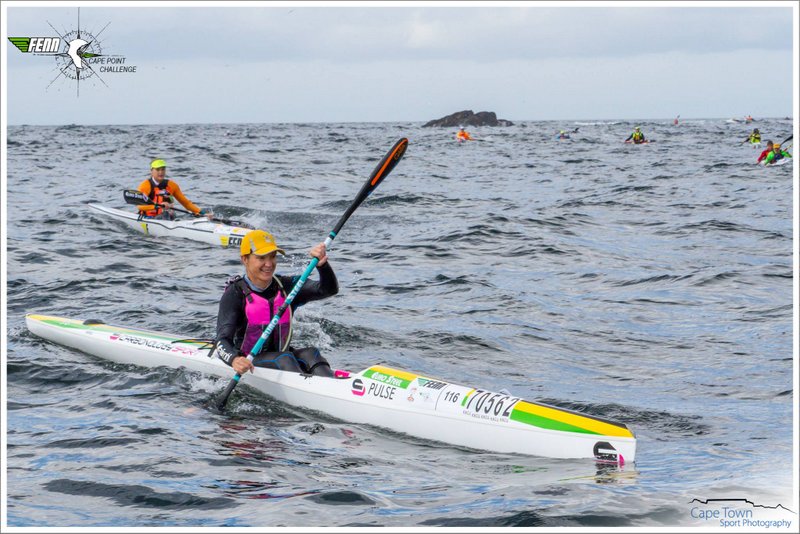
Hayley Nixon and Bridgitte Harley round Cape Point
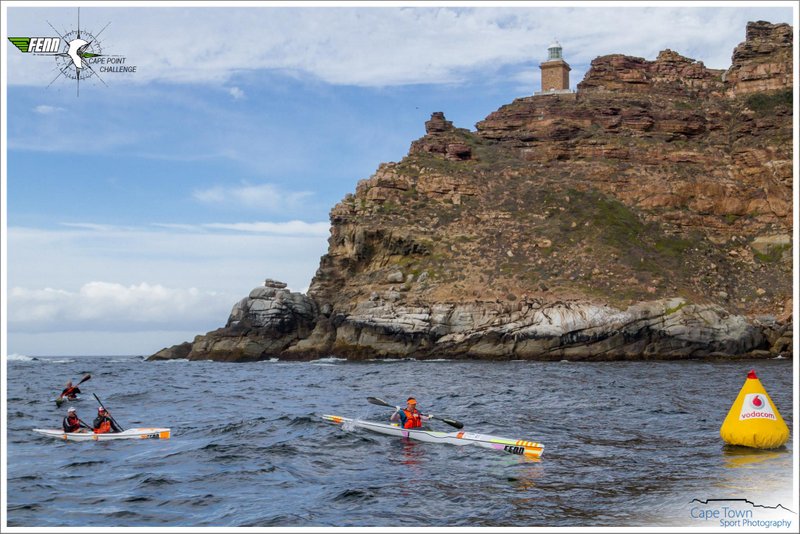
Bianca Beavitt approaches the turn buoy at Cape Point
“It wasn’t a perfect line towards Fish Hoek at first,” said Nixon. “The runs were pushing left and I was conscious of having to work right to avoid ending up too close inshore.
Spectacular
“But after Miller’s Point we had 12km of spectacular downwind. I was looking over my shoulder for the others but I felt good and knew that there was nothing more I could give it.
“Even the wildlife was incredible,” said Nixon. “A seal came surging through a swell, saw me at the last moment and did a convulsive backflip. I think it got the fright of its life!
“I had a group of penguins swimming alongside too,” she added. “It’s such a special place to race.”
But when she reached what she thought was the finish, she was greeted by anguished yells from the spectators – she’d missed the gate and had to relaunch, paddle out and around the buoy to finish correctly. “The buoys were set quite far to the right of the straight line to the beach,” she said, “and I simply didn’t see them.”
Fortunately she was far enough ahead of second place Bridgitte Hartley that the mishap didn’t cost her the race.
It was Nixon’s second consecutive Cape Point victory.
Shout out to the NSRI
As always, a shout out to the National Sea Rescue Institute crews who gave of their time to escort the race fleet. Surfski in South Africa has a strong relationship with these guys who are alway there with compassion and professionalism to pick up the pieces when we find ourselves in need.
The casualites were minor; a single ski became too tippy for an exhausted paddler; a double broke rudder and another a rudder cable. All were picked up promptly.
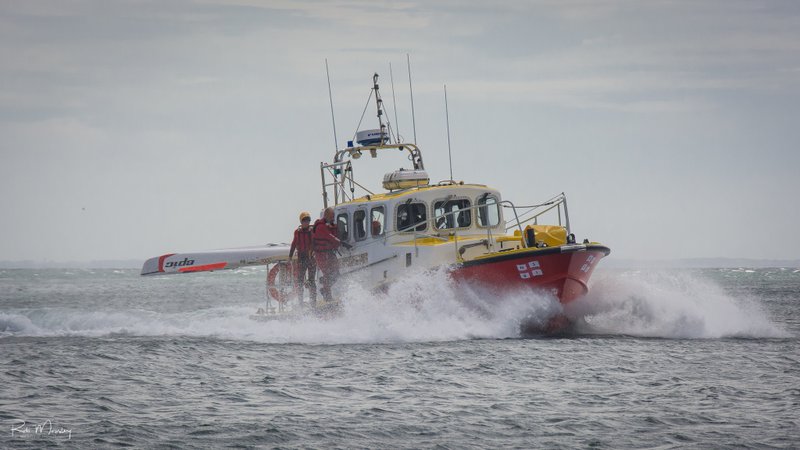
NSRI Station 10's Spirit of Safmarine speeds into Simon's Town harbour.
Summary Results
Click here for the full results
Singles – Men
- Kenny Rice 4:00:52
- Hank McGregor 4:04:23
- Nicholas Notten 4:05:08
- Jasper Mocke 4:06:34
- Yannick Laousse (France) 4:07:19
Singles – Women
- Hayley Nixon 4:43:52
- Bridgitte Hartley 4:48:25
- Bianca Beavitt 4:50:58
- Kyeta Purchase 4:51:48
- Chloë Bunnett 5:07:56
Fenn Cape Point Challenge 2017 – what you need to know
Written by Rob MousleyTwo days out from the race, the weather forecast seems to have settled on a moderate southeaster for Saturday morning, which is good news for the paddlers!
Additional Info
-
Content Part 2
Platboom
Another 10km and you’re opposite the beach at Platboom. This is a potential abort point, although there can be a bit of a break just offshore and care should be taken when coming in.
Kelp Beds
Along this section of the coast there are huge beds of kelp and a vital tactical decision must be made whether to go on the inside, potentially risking time lost when your rudder catches on the mats of weed, or to paddle a longer route on the outside.
Cape of Good Hope and Cape Maclear
By the 25km mark, you’ll be passing the Cape of Good Hope and Cape Maclear with the Diaz Beach just beyond. Things to note in this area:
Depending how far out to sea you are, Cape Point may be hidden behind Cape Maclear. And the first time I did the route, I saw Cape Hangklip (40km further across the other side of False Bay) and thought it was Cape Point – which didn’t do my morale any good at all.
Diaz Beach is very steep and has a very hard shore break – it’s not advisable to try to come in on a surfski.
The section from Cape Maclear to Cape Point is exceptionally rough – the huge Atlantic swells roll in, smash against the sheer cliffs and reflect out to sea again, causing a maelstrom of colliding waves. Truly a testing final 4km before you round the Point!
Cape Point
Around the 27km mark, you’ll be rounding Cape Point. No matter how many times you’ve done it, it’s worth glancing up at the cliffs – half way up, the “new” lighthouse perches on the rocks. It’s the most powerful lighthouse on the South African coast. The “old” lighthouse sits right at the top of the 300m cliffs. And is so often hidden in cloud that it wasn’t a reliable warning – hence the location of the replacement light.
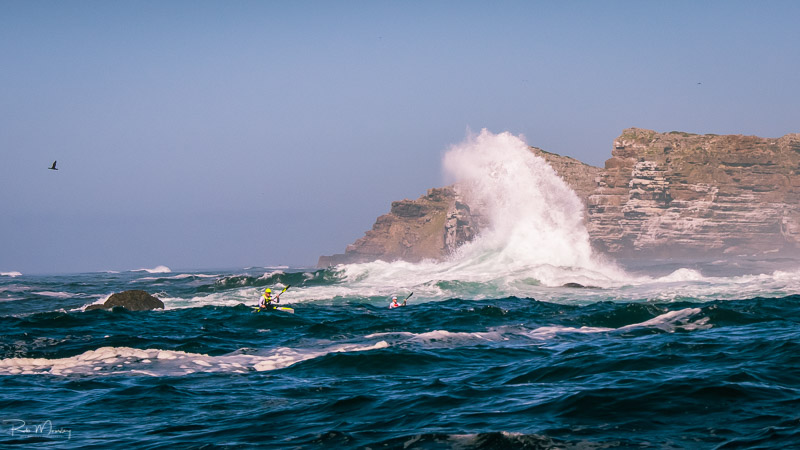
Taking the tiger-line at the Point
The elite paddlers tend to go inside the rock at the point, but take great care in this area; the gap can close out completely and it was here that one of the leaders was capsized and injured when a breaking wave hit him.
Most often you’ll have to go around a buoy set just inside the bay; an official in an escort boat will register your number to be sure that you’ve made it this far.
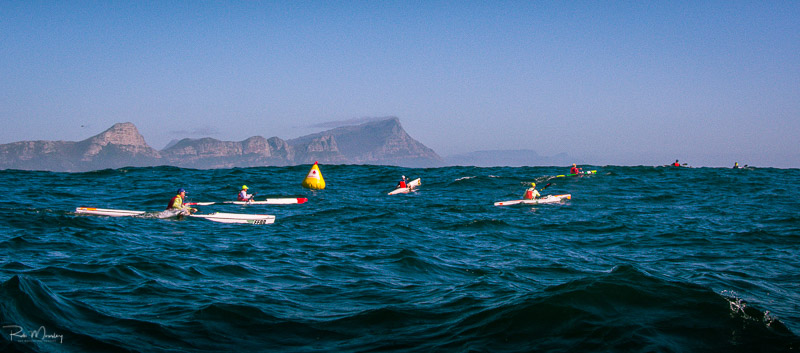
Homeward bound - around the buoy and downwind to Fish Hoek
Cape Point to Fish Hoek
On a good year (and it looks as though 2017 will be such), the run in from the Point to the finish is assisted with a strengthening tail wind. The runs are sometimes initially a little side-on, pushing you left towards Smitswinkel Bay and you need to work right so as not to end up too close in. But the runs from Smits onwards get better and better, and you cover the famous Miller’s Run, favourite of the Fish Hoek downwind paddlers, from Miller’s Point to Fish Hoek.
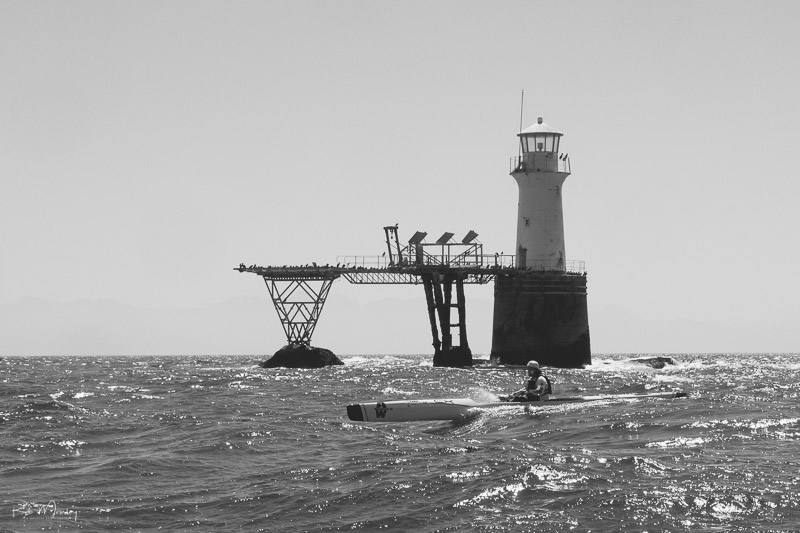
Craig Flanagan passes the iconic Roman Rock lighthouse in False Bay. 5km to go!
You’ll probably end up paddling more like 54km, depending how wide you took Cape Point.
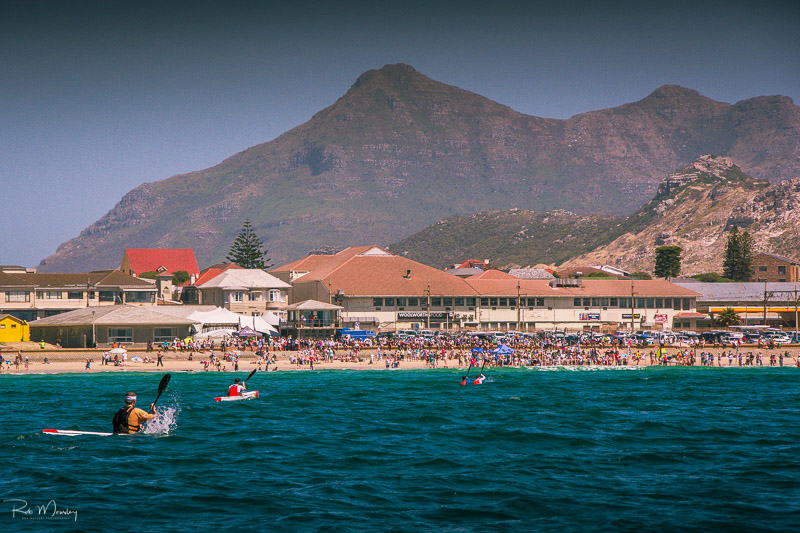
The crowd awaits - and so does an ice cold beer - or three!
So who’s in contention to win this 25th edition?
Hank McGregor has to be a solid favourite: he’s won it no fewer than seven times, for the first time in 2008 and then every year from 2011 onwards. (He's also won the race twice in the doubles category)
Also in the front bunch should be Hank’s Epic Kayaks teammate Jasper Mocke, 2nd last year and in 2015 and Kenny Rice, who’s had a spectacular run in the World Surfski Series this year, winning the Gorge Downwind Champs in the USA and Breizh Ocean Race.
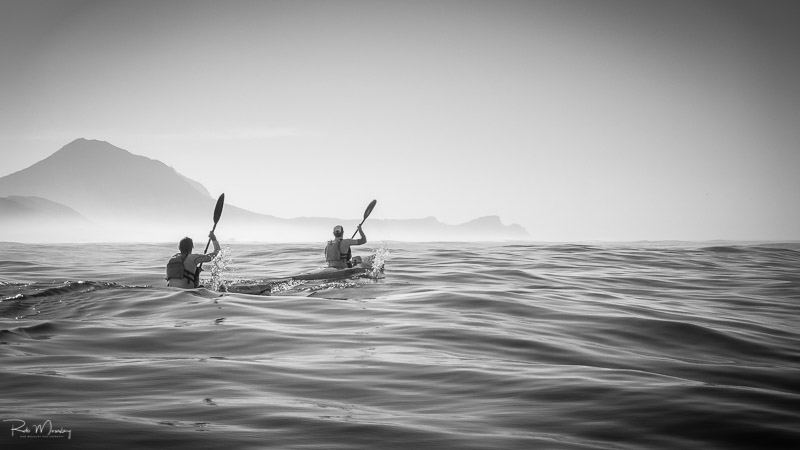
Hank McGregor and Jasper Mocke head towards Cape Point - 2016
Yannick Laousse (France) who’s been raging on the Miller’s Run for the last week came 4th in last year’s Cape Point.
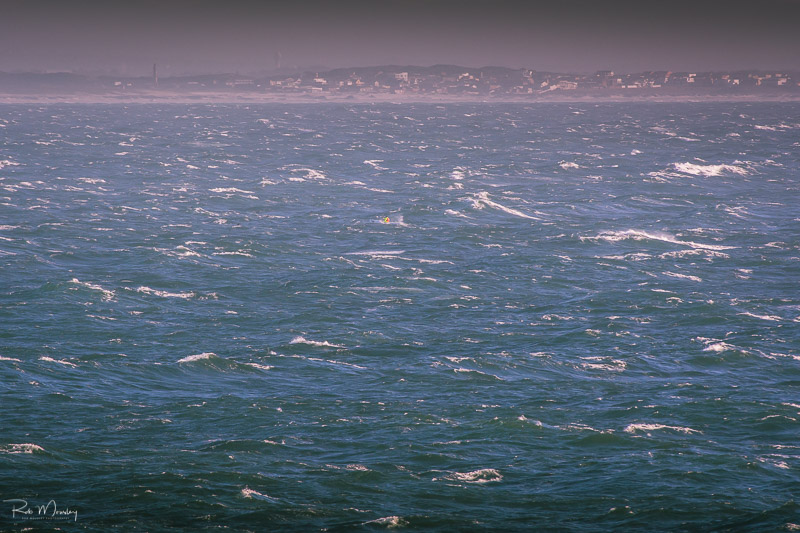
Yannick Laousse - riding the big swells on a Miller's Run a few days ago
Esteban Medina (Spain) came second at EuroChallenge to Sean Rice this year and 4th in the Dutch Coast race.
Noé Pelizza (France) will also be in the front bunch.
Women’s Race
This should be a fascinating race with local favourite Bianca Beavitt up against world-travelling Durban star Hayley Nixon, the newly crowned ICF Ocean Racing World Champion and 2016 World Surfski Series Champion.
Last year Beavitt came second to Nixon by just over two minutes.
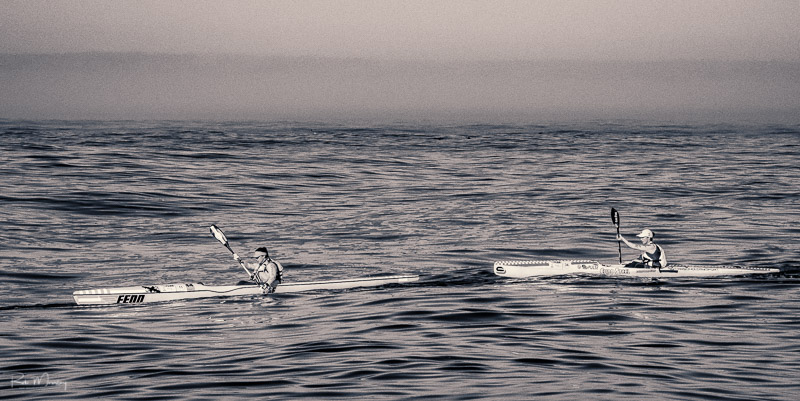
Bianca Beavitt and Hayley Nixon on their way to Cape Point - 2016
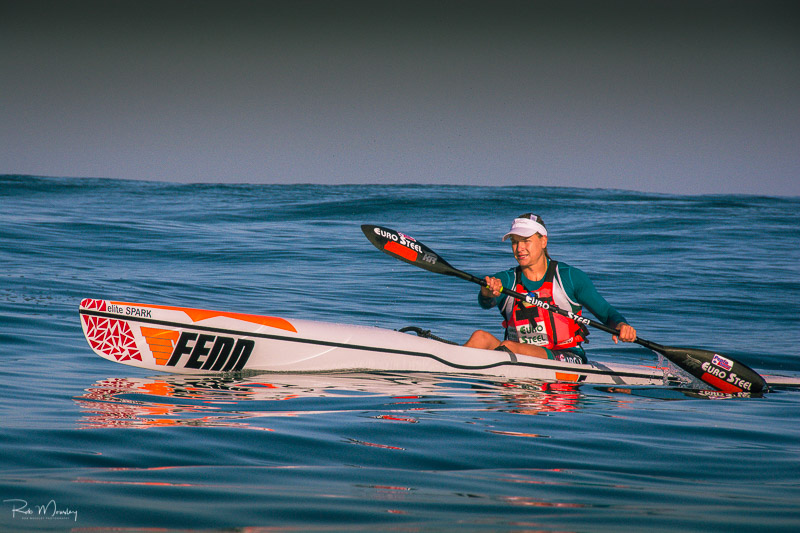
Bridgitte Hartley - 3rd in 2016
Olympian and last year’s third place Bridgitte Hartley will also be at the front of the pack, as will fellow Durbanite Kyeta Purchase.
For more information
As he fell off his ski yet again, Tim Wightman felt panic starting to well up. If he didn’t get back on and paddling in the next few moments, the gale-force wind and breaking waves would drive him onto the jagged rocks of Miller’s Point. “Calm down!” he yelled to himself. “Take it slowly!” “This time, stay in the f%#$ing boat!”
Additional Info
-
Content Part 2
Injury
“But things were about to get worse. On about the 4th or 5th dismount, I twisted my body and leaned hard over to my left side to avoid falling in again, when I felt a sharp pain and a crunching sound at the base of my rib cage. I released muscle tension and fell into the water. There wasn't much time to work out what happened and so my dismount/remount cycle continued, but with the added spicy ingredient of acute abdominal pain.
“I was getting closer and closer to the rocks and the waves were washing completely over them. My energy was sapping away, muscles were sore, my balance was totally shot and my rib cage was not in a good way. I somehow managed to calm myself and forego use of the rudder pedals, paddling slowly out to sea through the swell with both feet dangling in the water. At this point any thought of finishing the Miller's Run was ancient history, and I was purely focussed on getting myself back to the shore and saving my boat, although I would happily have sacrificed the latter and swum back had the need arisen.”
To his relief he finally managed to paddle his ski beyond the furthest rocks of Miller’s Point itself and turned the ski downwind.
“For a fleeting moment, I entertained an optimistic thought of catching up to the others who were probably already at Roman Rock lighthouse.
“It was then that I understood the problem with the rudder. Each time I tried to steer, the rudder would get stuck, I would need to push harder and harder, until it suddenly released - the result was a swim each time this happened, with resultant rib pain, cold and more loss of energy. At least I was beyond the rocks so the initial danger was now gone. I started eyeing the coastline for a landing spot that would cause the least amount of damage and pain, and steered back into shore.
“At this point I was starting to get the hang of the compromised rudder - by pushing hard with both feet at the same time, and then slightly more with one pedal, I could get it to release in a more controlled fashion and I only swam perhaps twice more. In my calmer state of mind, I also recalled that there was another slipway at Miller's Point on the sheltered side, and I turned south, into the wind, to find it.
“The paddle was uneventful from that point on, although the pain from my ribs was getting more noticeable and I was having to paddle hard directly into the southeaster to get back to the slipway. I made it back, hauled my ski up the ramp and lay down next to it, exhausted.
“After a few minutes, I set my mind to next steps. Here I was, alone at Miller's Point, quite a distance from any houses, and the light was starting to fade. The wind was still howling and being wet to the core, I was starting to shiver uncontrollably, which hurt my ribs even more.
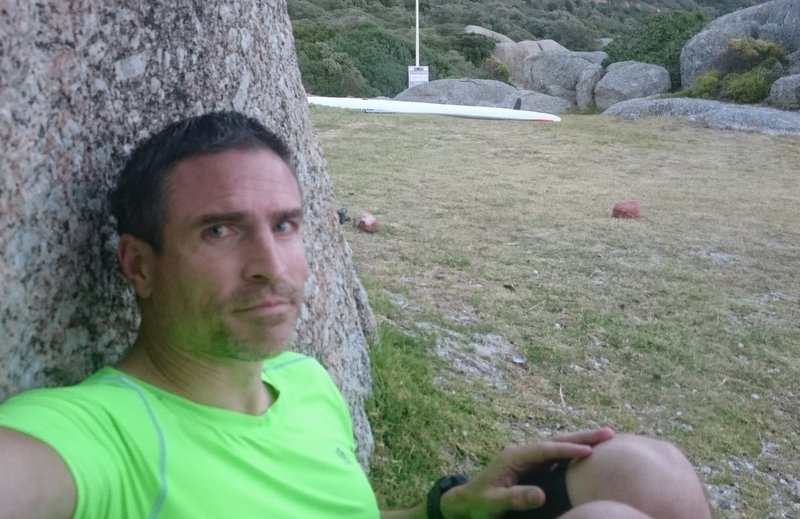
"...sheltering from the wind behind a rock"
Having sent a WhatsApp message to the others, Tim settled down to wait, sheltering from the wind behind a rock. It was almost dark by the time Gary received the message. He hastily changed and hurried back to Miller’s Point. Tim had spent over an hour shivering in his wet gear.
“I arrived home a little after 9pm. Having initially set out at about 4:30pm, that equated to 4.5 hours of driving and dicking around, all for 40 minutes of thrashing about in a cold, tumultuous ocean ending up with a bent rudder and a rib injury. Not my best day out....
-
Content Part 3
Diagnosis: Costochondral Separation
“I had a painful night's sleep - lying down definitely worse than when standing or sitting.
“Gary is a doctor, so he popped round the following morning for a coffee and had a prod around my ribs. He reckons the bottom left rib has separated from the cartilage, which would explain the popping / wrenching feeling I had when the injury occurred.”
https://mddk.com/costochondral-separation.html
“It is quite disconcerting when I roll over in bed,” Tim laughed. “I can feel something moving around as though it's loose... which I guess it is.”
"Relive-ing" the nightmare
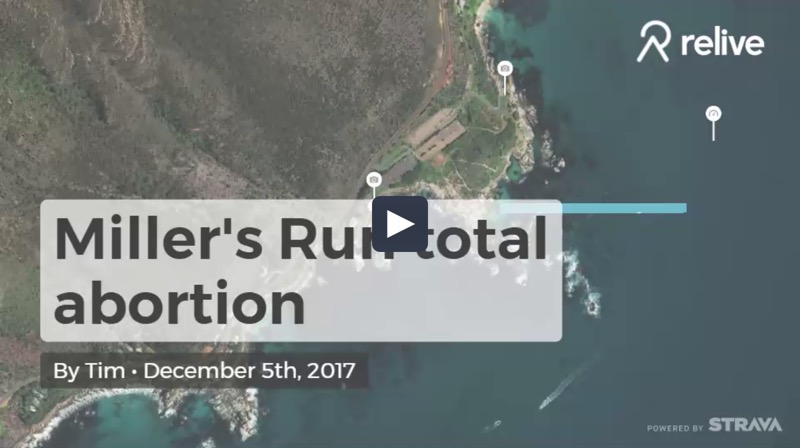
https://www.relive.cc/view/1303386297
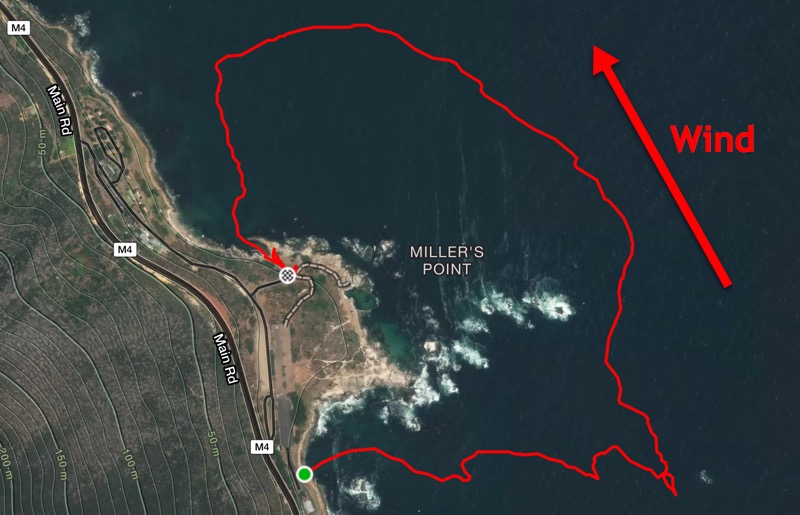
Tim's GPS track. Bakoven Rock, the starting point of the Miller's Run can be seen lower right.
https://www.strava.com/activities/1303386297
Learnings
Tim said he wouldn’t have done much differently safety-wise. He knew the rudder had scraped over the concrete ramp, but he wasn’t aware that it had actually been damaged until much later.
The others had looked for him at the rock, but had assumed that he’d turned early and headed for Fish Hoek. [Editor: I have been in the same situation – it’s not uncommon that guys struggling to get to the rock turn early. And when it happens, you’re left in an acute dilemma: do you go back towards the ramp, and put yourself back in the danger zone windward of the rocks, or do you assume that the other paddler has turned early? The only solution to this one is to buddy up right from the ramp.]
Tim said, “The recent article on surfski.info about whether to go or not to go in extreme conditions is very pertinent: the conditions last Tuesday, coupled with the time of day (6pm start) as well the fact that I hadn't done a Miller's Run in a couple of years, probably pointed to the fact that I should have considered pulling the pin.
“However at what point do you make that choice? Once you're in the taxi and you get to Miller's, do you decide to keep the ski on the trailer and get driven forlornly back to Fish Hoek? Or do you head out from the slipway and give it a go for a few minutes and turn back if it's too hectic?
“Hard to know what the right answer is, but it helps that there is the other slipway that is sheltered if you have a problem early on and decide to turn back.”
Latest Forum Topics
- No posts to display.